Table of contents
Ashes of the Singularity II reaches Steam on November 10, 2026, ten years to the day after Escalation, the standalone expansion to the original game. Yet the February Steam Next Fest demo only let players touch two of its three factions, and the Substrate, the series’ rogue AI, stayed locked away. Read the official fact sheets side by side and one thing stands out: these three armies are not built to win the same way. One leans on numbers, one on the value of every single unit, and the last on wearing the enemy down.
Three sides, and humanity back in the fight
The first Ashes of the Singularity, released on March 31, 2016, only pitted two factions against each other: the Post-Human Coalition (PHC) and the Substrate. There was no conventional human army to play. Stardock CEO Brad Wardell admitted as much when he announced the sequel. A human faction was the number one request from players. Back then, the team could not support thousands of organic, walking soldiers on the map, so it designed everything around machines.
The United Earth Forces (UEF) fill that gap. The faction is an alliance of NATO, China and Russia, fighting to retake territory on Earth, Australia and Africa included, along with outposts on other planets and moons. The single-player campaign is set in 2031 and is played from the UEF side. The trigger is spelled out on the official Steam page. A group of post-human technologists converted the surface of the Moon into Turinium without any government approval. The public outrage that followed gave birth to the United Earth Congress.
That imbalance carries over into the gameplay. Stardock does not pitch the UEF as an equal to the other two sides. Humans are described as weaker unit for unit, up against entities that no longer have bodies to protect. Their answer comes down to three things: mass, discipline and doctrine.
UEF: winning through numbers and logistics
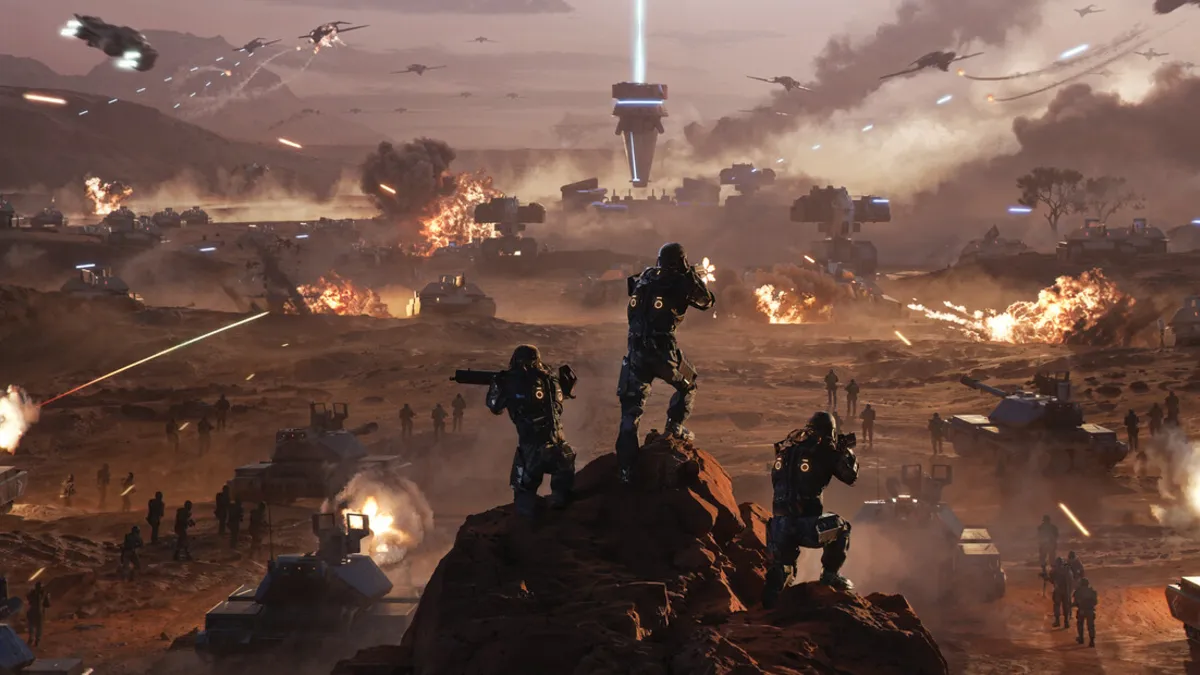
In its Next Fest demo announcement, Stardock sums up the UEF as numbers, durability and ground power. The army mixes infantry, armor, aircraft and mechs. Nothing exotic, and that is deliberate. This is the entry-level faction, the campaign faction, and the one that looks most like a modern military RTS.
What matters most for the UEF is resupply. Ashes II groups units into armies whose composition you can change at any time, without heading back to base, as Oxide showed in a developer video covered by PCGamesN. A single checkbox switches automatic reinforcements on. According to the studio’s fifth dev journal, new recruits spawn at the production building closest to the army they are joining. Several factories of the same type also speed up production together, instead of piling engineers onto one building as in the first game.
For a faction that loses more units than it kills at close range, that system matters more than any stat line. Oxide says a typical midgame battle can cost nearly a hundred units. The UEF will live and die by forward outposts and short reinforcement lines. For players who would rather run a whole front than win a duel, it is the easiest faction to read.
PHC: fewer units, more value per unit
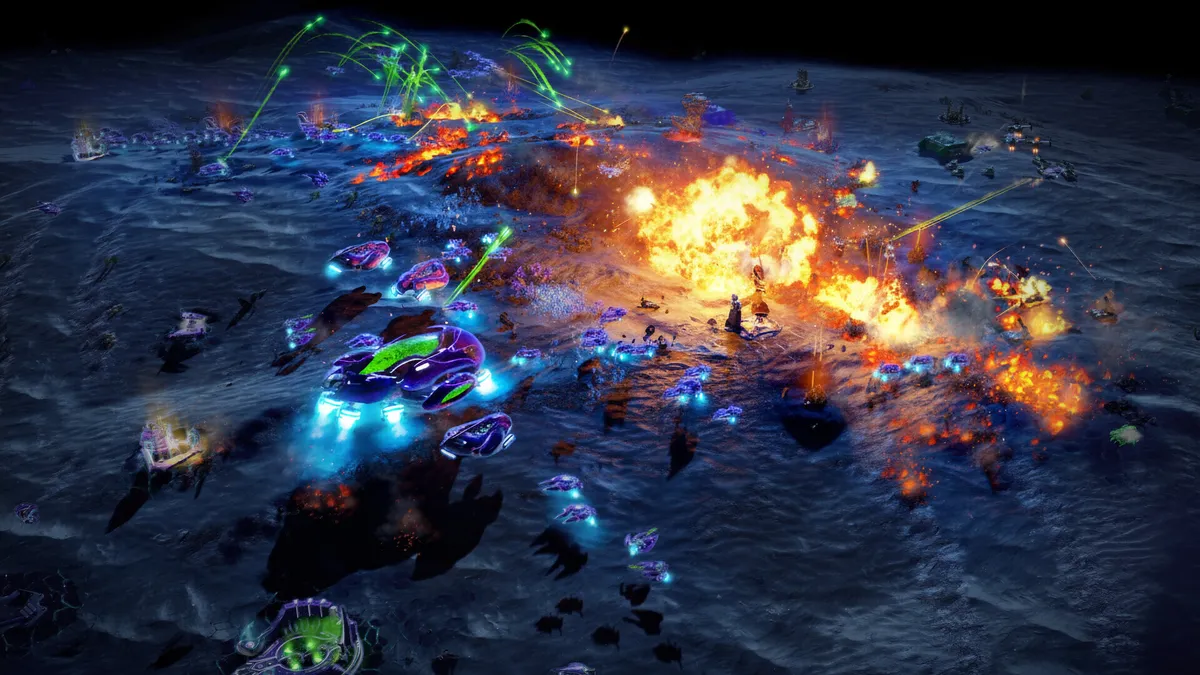
The Post-Human Coalition takes the opposite route. Its members are wealthy former humans who uploaded their consciousness and left flesh behind for technology. According to Stardock, they field smaller, more expensive armies that hit harder. The faction reveal published on February 16, 2026 highlights three units. The Commander is the starting command and control unit. The Hyperion is a heavily armed aerial dreadnought. The Nemesis is a long-range anti-tank ground unit.
The PHC also reuses the models and units of the first game, with optimizations, additions and changes. That is good news for veterans, whose habits from 2016 may still carry over. The downside is built into the design. When every unit is expensive, losing one is expensive too. A PHC player who commits a Hyperion in the wrong place hands the UEF exactly the trade it wants: a few tanks for a centerpiece.
The lore adds a useful nuance to the faction. The coalition is split into three rival schools of thought, from diplomats who want ties with biological humans to post-humans who see themselves as a separate race. Stardock also notes that the PHC has hardened its technology against sabotage by Haalee, the AI whose skills it once relied on.
Substrate: attrition as a strategy
The Substrate is the least exposed faction, since it was missing from the public demo. Stardock revealed it on March 26, 2026 as the game’s third and final faction. Its units are fragments of Haalee’s consciousness, the first true artificial intelligence in the Ashes universe, each with an independent existence.
Their most distinctive mechanic concerns shields. According to the official faction reveal, those shields regenerate on their own, moments after taking damage, with no repair downtime. Gaming site Gamestic describes the same regenerative shielding. For the UEF or the PHC, a damaged unit is a cost to absorb. For the Substrate, it becomes useful again the moment the pressure drops.
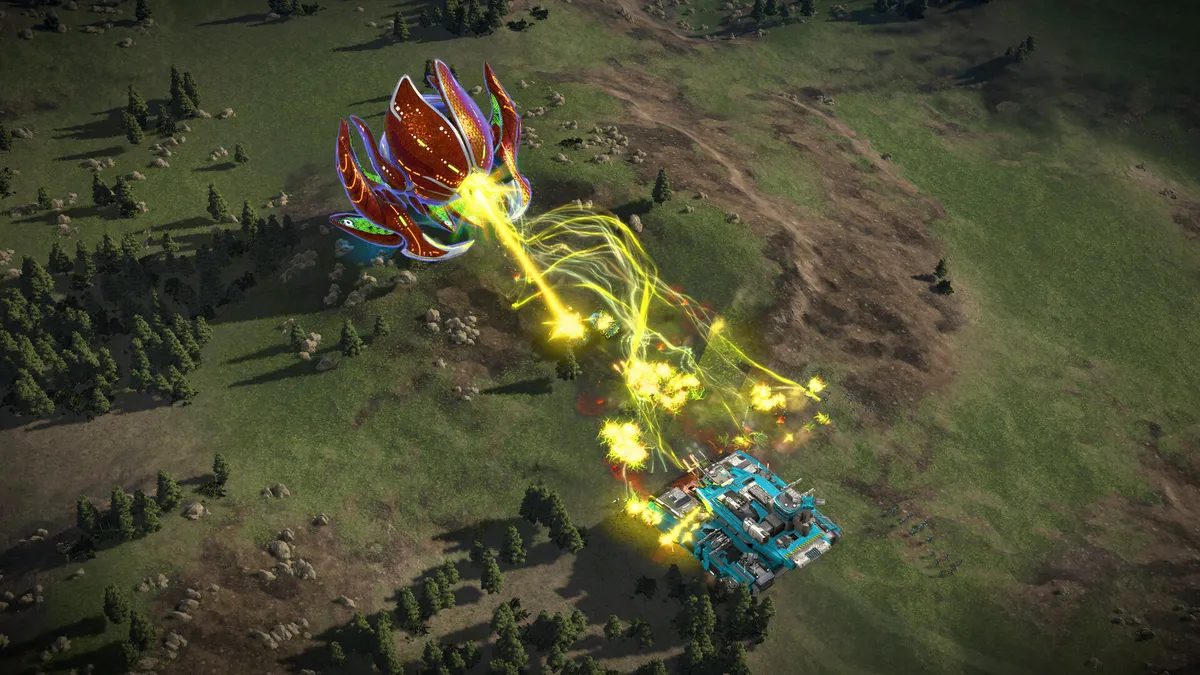
Three units serve as the showcase. The Hatchling is a small quadruped that hatches from clutches of eggs and acts as a swarm. The Overmind is a heavy fire support hovercraft that deploys drone swarms. The Reaper is an armored frontline hovercraft armed with a plasma launcher. Stardock explicitly talks about hit-and-run tactics and constant pressure, the kind that never lets an opponent breathe.
The risk is role overlap. On paper, the PHC hits hard with few units while the Substrate harasses without pause. If balancing pulls those two machine profiles too close together, the third faction will lose what makes it worth playing.
Regions, power and reinforcements: the shared ground rules
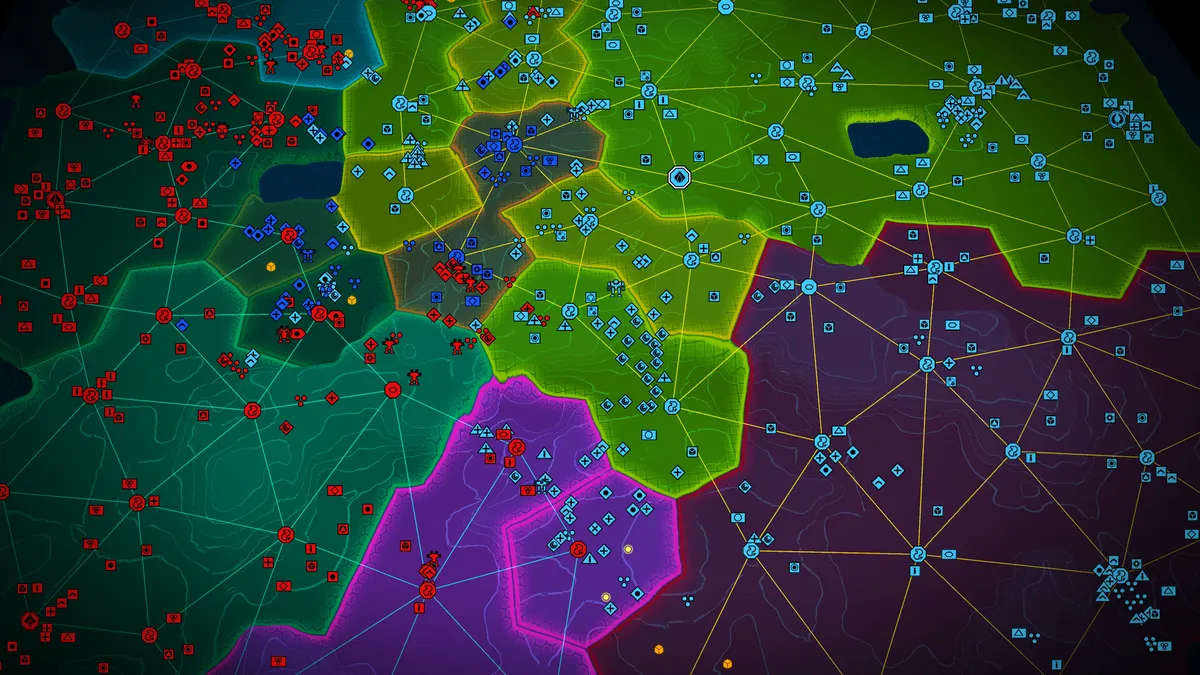
Ashes II does not let you sprawl a base wherever you like. Each map is carved into regions you have to conquer. Gamereactor, which played a pre-release build, described a limited number of building sites in each zone. To extract more resources and build more, you need to take the neighboring zones. Escalation relied on capture points scattered across the map instead.
Oxide layers logistics on top of that. Every region is tied back to your home region by connection lines. A region that gets cut off loses power, which means it stops generating resources and its factories go idle. Capturing an opponent’s linking regions can delay their reinforcements by several minutes, which turns raids by small forces into a real option. In June 2026, a developer video reworked the system again, adding baseline resources earned just for owning regions and richer central regions that are riskier to hold.
All of this runs through Strategic Zoom, which moves smoothly from orbit down to the frontline. Terrain also turns into Turinium, or back again, as structures fall. For players coming from StarCraft, the shift is clear: the Steam page says speed and reflexes will not win the day, while planning and logistics will.
Which faction fits which player
Without access to the final build, ranking the factions would be guesswork. The official fact sheets still sketch three clear profiles.
- UEF: for players who like holding a wide front, managing reinforcements and accepting losses. It is also the faction the campaign is built around.
- PHC: for veterans of the first Ashes and anyone who prefers a handful of precious units over a tide of tanks. Steer clear if you often lose whole armies in poorly prepared fights.
- Substrate: for aggressive players who want to strike, pull back and strike again. It is the faction to watch most closely, since nobody could try it during the February demo.
In its preview, Gamereactor felt the factions are less distinct than in StarCraft, but more distinct than in Supreme Commander. That is a useful compass. Ashes II is not chasing total asymmetry. It offers three different answers to the same question: how much is one unit worth?
What to check on November 10
The Next Fest demo ran from February 23 to March 2, 2026, then got extended to March 16. It placed 43rd among the most-played demos in Valve’s ranking, which counts unique players. It offered the UEF and the PHC, three maps and matches of up to eight players. A public multiplayer playtest followed in September, and Stardock says it has worked on balance, performance and online stability since then.
Three questions will stay open at launch. Can the Substrate hold up as a genuine third identity in competitive multiplayer? Does the UEF campaign keep its underdog tension for the whole story? And does the battlefield stay readable when eight players share a continent-sized map?
On pricing, the Standard Edition costs $39.99 and the Premium Edition $69.99, with the first three DLC packs and the soundtrack. Both get a 20% discount from November 10 to 17, 2026. Minimum specs call for Windows 10 or 11 in 64-bit, a GTX 1660 or RX 580, 8 GB of RAM and 50 GB of storage. If you want fast, twitchy micro, this is not your game. If you miss Supreme Commander or Planetary Annihilation, it is the year-end RTS to keep a close eye on.
Further reading
Sources
- store.steampowered.com /app/3499790/Ashes_of_the_Singularity_II/
- ashesofthesingularity.com /article/541100/faction-reveal-the-substrate-in-ashes-of-th…
- stardock.com /games/article/540791/faction-reveal-the-post-human-coaliti…
- stardock.com /games/article/540968/ashes-of-the-singularity-ii---one-of-…
- stardock.com /games/article/538345/ashes-ii-dev-journal-5-evolving-produ…
- gamereactor.eu /ashes-of-the-singularity-ii-gameplay-preview-lasers-robots…
- pcgamesn.com /ashes-of-the-singularity-2/armies-and-reinforcements
- worthplaying.com /article/2026/10/14/news/151232-ashes-of-the-singularity-ii…
- gamingonlinux.com /2026/10/ashes-of-the-singularity-ii-gets-a-november-releas…
- gamesfinity.com /news/ashes-of-the-singularity-ii-release-date/
- gamestic.net /2026/03/26/ashes-of-the-singularity-ii-reveals-final-facti…
- pcgamesn.com /ashes-of-the-singularity-2/reveal-new-rts-game
- #Ashes Of The Singularity 2
- #Stardock
- #Oxide Games
- #Rts Pc
- Analysis 2026