---
title: "Total War: Shogun's Story — How an Abandoned Monkey RPG Led to a Landmark Series"
description: "How Total War: Shogun (June 2000) came about after Creative Assembly dropped a planned Monkey RPG, and how a cheap strategy game became the first Total War."
url: https://after-strategy.com/en/total-war-shogun-history-creative-assembly-abandoned-monkey-rpg/
lang: en
published: 2026-10-26
author: "Simon Dougnac"
author_url: https://after-strategy.com/en/auteur/simon/
game: "Total War: Shogun"
game_url: https://after-strategy.com/en/jeux/total-war-shogun/
categories: [grand-strategy]
translations:
fr: https://after-strategy.com/fr/lascension-de-total-war-shogun-dans-lindustrie-du-jeu/
es: https://after-strategy.com/es/historia-total-war-shogun-creative-assembly-rpg-monkey-abandonado/
publisher: "After Strategy"
---
# Total War: Shogun's Story — How an Abandoned Monkey RPG Led to a Landmark Series
> How Total War: Shogun (June 2000) came about after Creative Assembly dropped a planned Monkey RPG, and how a cheap strategy game became the first Total War.
## Total War: Shogun's Story: How an Abandoned Monkey RPG Led to a Landmark Series
[Shogun: Total War](https://after-strategy.com/en/jeux/total-war-shogun/) reached North American shops on 12 June 2000 and European ones four days later, published by Electronic Arts. It is the game that put Creative Assembly on the map, yet it started as a fallback. Before it, the studio had planned an RPG based on the TV series Monkey, itself adapted from the Chinese classic Journey to the West. That project was dropped, and a modest strategy game took its place. Here is how that detour produced one of the best-known names in strategy gaming, and why the popular version of the story gets it wrong.
- **Creative Assembly** first planned an RPG based on the TV series Monkey, to be made in Singapore.
- That RPG was **abandoned**, and the team made **Shogun: Total War** instead. Shogun did not "fund" the RPG.
- Released on 12 June 2000 (North America) by **Electronic Arts**, it was the **first Total War** game.
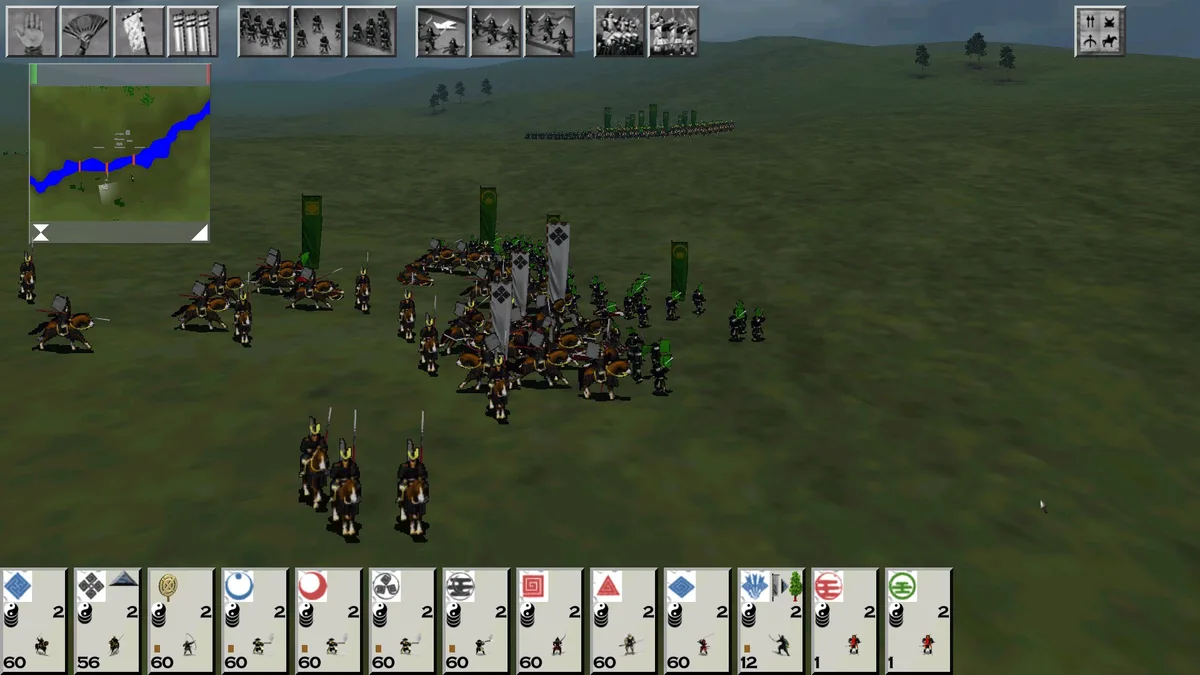
- Seven clans fight over Sengoku-era Japan on a **turn-based campaign map**, with **real-time battles** fought by sprite armies on 3D terrain.
- An expansion, **The Mongol Invasion**, followed in August 2001, alongside the **Warlord Edition** bundle.
### Creative Assembly Before Shogun
Tim Ansell founded Creative Assembly in 1987, and for years the studio lived on conversions and licensed sports titles. From 1993 it worked under the EA Sports label; in a 2011 retrospective with Funambulism, Mike Simpson recalls a team of about five people producing the first PC version of FIFA. Simpson himself was hired in 1996 as creative director, with the brief to start a second team doing something different.
That something was supposed to be a role-playing game based on Monkey, developed in Singapore to take advantage of large government tax breaks. By Simpson's account, those breaks turned out to be less attractive than they looked on paper, and the RPG was shelved before it went anywhere. Creative Assembly's own 30th-anniversary trivia, published in August 2017, tells the same story: Shogun started life as an RPG based on Journey to the West, and the team very nearly relocated to Singapore. Nothing in either account suggests that Shogun was made to pay for the RPG: one project replaced the other.
### From a "B-Grade C&C Clone" to Shogun
With the RPG gone, the team looked at what was selling. Command & Conquer had spawned a wave of imitators, so the plan became, in Simpson's words, "a B-grade C&C clone": a cheap 2D real-time strategy game. Two things changed it along the way. First, 3dfx graphics cards made real 3D terrain possible on PC. Second, the battles on their own felt too short and too disconnected, so a campaign map was added to give each fight a reason. Artist Nick Tresadern, who joined when the Total War team was about seven people, told PC Gamer in 2020 that the map was there so players would choose which army to attack and why.
Shogun was announced in early 1999, a demo went out in January 2000, and EA published the full game that June. The "Total War" brand existed before the Japanese setting was even settled, which is why the studio could move the formula to Europe so quickly with Medieval: Total War in 2002.
### What You Actually Played in 2000
On the campaign map, Japan is split into provinces during the Sengoku period, the "Warring States" era of rival daimyo. You pick one of seven clans and move armies and agents on a Risk-style board where each turn is a season. Provinces produce koku, the rice-based currency that pays for castles, ports, dojos and troops. Emissaries handle diplomacy, while ninja and shinobi spy and assassinate. Portuguese traders bring arquebuses, and converting to Christianity unlocks better trade at the cost of unrest. Neglect public order and a province can rise against you.
Battles switch to real time. Each unit is a block of 2D sprites on a 3D battlefield, and memory was so tight that soldiers walking left were simply a mirrored sprite, Tresadern recalls. Morale, fatigue and weather mattered: in heavy rain, early arquebuses could fail to fire, and units whose morale broke would rout from the field. The battle AI drew on Sun Tzu's The Art of War, military historian Stephen Turnbull advised on the period, and Jeff van Dyck wrote the score. GameSpot named it Best Strategy Game of 2000.
### The Mongol Invasion and What Came Next
Released in August 2001, the expansion added a playable Mongol faction, new units, two campaigns and a map editor. Its premise imagined Kublai Khan's fleet reaching Japan instead of being wrecked by storms. North America got it as part of the Warlord Edition, which bundled the base game and the expansion. Creative Assembly returned to the setting a decade later with [Total War: Shogun 2](https://after-strategy.com/en/jeux/total-war-shogun-2/), released on 15 March 2011. Rome: Total War (2004) was the entry that finally replaced the sprites with 3D soldiers.
### Our Take: The Abandoned RPG Was the Lucky Break
What matters in this story is not the lost Monkey game, but how little the winning idea was planned. The popular version, in which Shogun was a cash cow built to finance a dream RPG, flatters the RPG and misreads the studio. In practice, Creative Assembly had built its name on conversions and sports games, not role-playing games, and the project depended on a tax incentive that did not survive a closer look. Shogun worked because a small team accepted a narrow, cheap brief, then let the design change when the hardware and the playtests told them to. The campaign map, now the heart of every Total War, began as a fix for battles that felt pointless.
That is the real lesson for the series today. The difference between Shogun and a forgotten C&C clone was not budget but focus: one setting, one clear tension between the map and the battlefield. Nostalgia for the RPG that never happened is understandable, but the version of Creative Assembly that dropped it is the one that built a series still running 26 years later.
### Conclusion
Total War: Shogun began as a replacement for a cancelled RPG and a deliberately modest RTS, then grew into the template for every Total War since. The Monkey RPG stayed on the drawing board, and nothing suggests the studio ever went back to it. Shogun's koku, clans, sprite armies and season-by-season campaign are where the series' identity comes from.
## See also
- [Game hub — Total War: Shogun](https://after-strategy.com/en/jeux/total-war-shogun/)
- [Shogun 2, the 2011 return to Sengoku Japan](https://after-strategy.com/en/jeux/total-war-shogun-2/)
- [Total War: Warhammer 40,000 — first gameplay and closed beta](https://after-strategy.com/en/total-war-warhammer-40000-first-gameplay-reveal-closed-beta-2026/)
- [Nagash and the Lords of the End Times for Warhammer 3](https://after-strategy.com/en/total-war-warhammer-3-lords-of-the-end-times-nagash-summer-2026/)
- [All grand strategy games](https://after-strategy.com/en/categorie/grand-strategy/)
- [All RTS articles](https://after-strategy.com/en/categorie/rts/)
## Sources
- [Total War — official site](https://www.totalwar.com/)
- [Creative Assembly retrospective with Mike Simpson — Funambulism (2011)](https://funambulism.com/2011/11/14/creative-assembly-interview-huge-retrospective/)
- [20 years ago, Shogun: Total War started a long legacy — PC Gamer (2020)](https://www.pcgamer.com/20-years-ago-shogun-total-war-started-a-long-legacy-but-it-was-almost-a-very-different-game/)
- [A Retrospective of Shogun: Total War — No Dice No Glory (2024)](https://nodicenoglory.com/a-retrospective-of-shogun-total-war/)
- [The Mongol Invasion — Total War Wiki](https://wiki.totalwar.com/w/The_Mongol_Invasion.html)
- [Shogun: Total War — Wikipedia](https://en.wikipedia.org/wiki/Shogun:_Total_War)
- [Creative Assembly — Wikipedia](https://en.wikipedia.org/wiki/Creative_Assembly)
- [Creative Assembly turns 30 — CGMagazine (2017)](https://www.cgmagonline.com/news/creative-assembly-turns-30/)
## Frequently asked questions
### How did Total War: Shogun come about?
Creative Assembly first planned an RPG based on the TV series Monkey. That project was dropped, and the team made a strategy game instead: Shogun: Total War, released in June 2000.
### Why was the Monkey RPG abandoned?
According to Creative Assembly's Mike Simpson in a 2011 retrospective, the RPG was to be developed in Singapore for tax advantages, which turned out to be less attractive than expected.
### How did Total War: Shogun change strategy games?
It combined a campaign map, where you manage provinces and resources, with real-time battles where you command units directly.
### Did Creative Assembly ever make its Monkey RPG?
No. The RPG was never made, and the studio went on to build its strategy franchise with the Total War series.
## Sources
-
-
-
-
-
-
-
-
Source : [Total War: Shogun's Story — How an Abandoned Monkey RPG Led to a Landmark Series](https://after-strategy.com/en/total-war-shogun-history-creative-assembly-abandoned-monkey-rpg/) — After Strategy