
Table of contents
- Endfield opens too many doors at once
- 1. Let the main mission open the game
- 2. Build a readable factory before a perfect one
- 3. Invest in a team, not a collection
- 4. Spend according to the next bottleneck
- 5. Explore with a question
- A simple routine for each session
- A three-session path
- First session: open the loops
- Second session: stabilize production
- Third session: choose the investments
- Troubleshooting an AIC chain without rebuilding everything
- Manage exploration as an extension of the factory
- The signs of healthy progression
- Sources
Endfield opens too many doors at once
The first difficulty of Arknights: Endfield is not a boss. It is the coexistence of campaign, exploration, team combat, recruitment and the AIC factory. Everything seems important, so the natural reflex is to touch everything. It is also the fastest way to scatter your materials.
A good start comes down to four priorities: unlocking systems with the main mission, stabilizing a small production, building a single coherent team and exploring to answer a specific need. Optimization comes afterwards.
1. Let the main mission open the game
The launch version reduced some Authority Level prerequisites and simplified the first Valley IV missions. Take advantage of this structure. As long as a central system is not unlocked, spending hours cleaning every detour can create resource stocks whose use is still unclear.
Progress until you understand the three main loops: what combat consumes, what exploration brings back and what AIC can produce. Then come back to the areas already crossed with a goal. This method avoids confusing curiosity with progression.
2. Build a readable factory before a perfect one
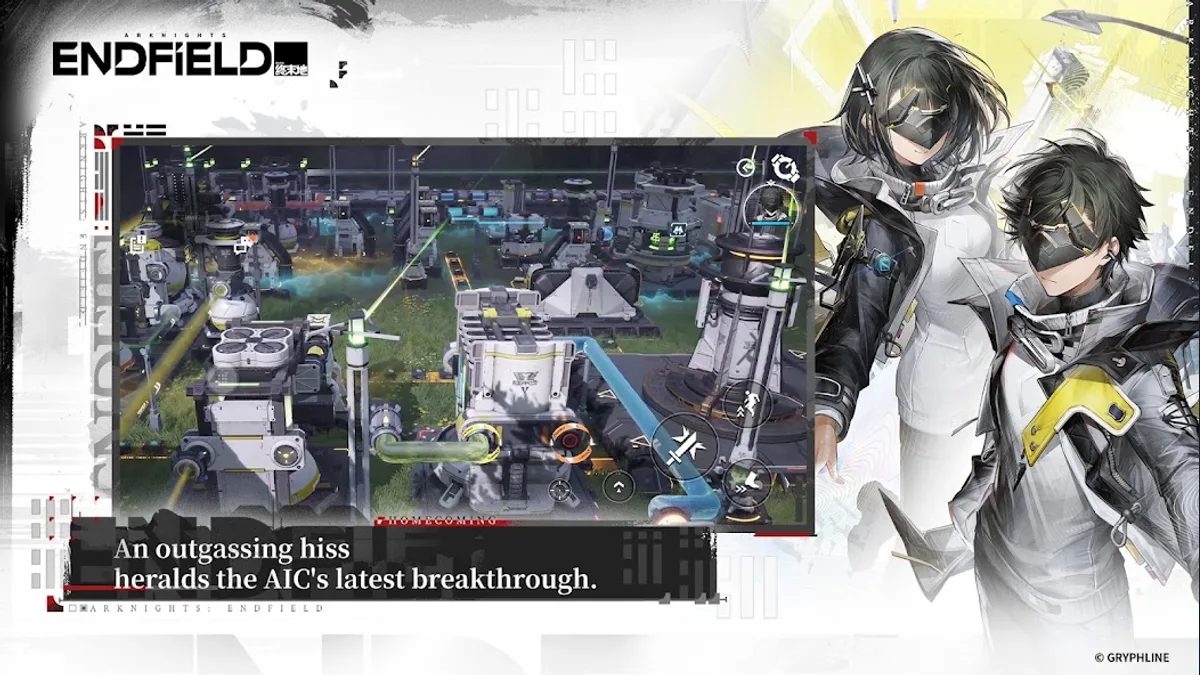
AIC rewards planning, but a huge installation you do not understand quickly becomes a problem that is hard to diagnose. Start with a short chain: one input, one transformation, one output. Check the conveyors, the pipes and the power before duplicating.
Connection indicators were improved in the final version, and updates kept softening the placement. That does not replace a personal convention. Keep free corridors, separate the lines and mentally name the function of each block.
When a production stops, trace the flow back from the output. Look first for a missing resource, a broken link or a lack of power. Adding a new installation before finding the bottleneck only grows the disorder.
3. Invest in a team, not a collection
Operators use physical alterations and Arts reactions. Choose a main family, then four characters able to prepare, amplify, trigger and secure this rotation.
Rarity is not enough. A new character can be excellent without completing your group. Check their tags and play their training stage when it is available. Before any significant spending, verify the exact place they take in the sequence.
The Endfield operators guide proposes a composition method without a tier list. To understand the states themselves, read our combat and reactions analysis.

4. Spend according to the next bottleneck
A material does not need to be spent just because it is available. Keep a reserve until you have identified the next obstacle: an operator level, a decisive skill, a weapon or a production chain.
The launch version lowered some ceilings and reinforced early material access. This generosity eases the start, but it can also give the impression that all upgrades are equal. Prioritize what makes your main team more consistent. A secondary character leveled “just in case” unlocks nothing today.
5. Explore with a question
Exploration pays off more when each detour answers an intention: finding a resource, opening a route, feeding a production or finishing a mission. Mark what you cannot exploit yet instead of insisting.
Chests received more Oroberyl in the final version, but the map should not become a list to empty before moving on. Alternate campaign and exploration. Systems unlocked later often give an old area a new meaning.
A simple routine for each session
At the start of a session, choose a single main goal: advance a mission, repair an AIC chain, progress an operator or explore a region. Then check whether the team and the production support this goal.
At the end, note the next bottleneck: operator material, AIC power, a Valley IV mission or a Wuling resource. This trace avoids relaunching Endfield two days later to wander between five menus.
If you change platforms, see our installation, requirements and cross-save guide. For an account problem, the support contact procedure lists the confirmed channels.
Mastery does not start with the densest factory or the rarest roster. It starts when you can explain what your next action will unlock.
A three-session path
First session: open the loops
Follow the main mission until you have handled team combat, exploration and a first AIC production. Do not try to cover the whole map yet. Simply note the resources required by the next upgrade and where they are produced.
In combat, keep the tutorial’s suggested group long enough to understand the skill order. Physical alterations use up to four Vulnerable charges; Arts reactions also rely on charges and their combination. Identifying one of these two axes already gives a direction to the future composition.
Second session: stabilize production
Come back to AIC with a specific product in mind. A simple line must have a fed input, a transformation machine, a continuous conveyor and an output. Use the formula menu indicators when the chain reports an anomaly.
Avoid gluing all the installations together. Leave space to add a pipe or move a building. Batch Mode and blueprints then make it easier to copy a set that works; they do not repair a line whose flow was never understood.
Third session: choose the investments
At this stage, note the four most used operators and their tags. Check which one applies the starting state, which one consumes it and which one keeps the team going. Use the available training stages before replacing a member.
Do not level two full teams at the same time. First keep four characters at the level the campaign asks for and one or two substitutes answering a specific constraint. This base limits the scattering of level, weapon and skill materials.
Troubleshooting an AIC chain without rebuilding everything
When a production stops, open the formula of the final product. Check the quantity of each ingredient and trace back to the first zero number. On the field, then follow the associated conveyor or pipe.
If the machines receive resources but stay inactive, check the power supply of the region. Recent versions added or announced several aids, including temporary backup power and more permissive pipe connections. These tools buy time to correct the plan; they do not replace sufficient electrical production.
A line saturates when the output does not consume fast enough. In that case, adding a machine upstream worsens the bottleneck. First enlarge the storage, the transport capacity or the final outlet.
Manage exploration as an extension of the factory
Valley IV and Wuling are not just maps to clean. Regional development links exploration, outposts, trade and AIC. A resource found on the field can open a blueprint, feed equipment or unlock a more efficient production.
Before a detour, ask yourself which loop it serves. A chest, a side mission, a transport point or a rare resource each have a different value depending on the current bottleneck. The detectors and compasses mentioned in official communications make searching easier, but the session goal remains the most reliable filter.
The signs of healthy progression
After a few hours, you should be able to name AIC’s main product, the reaction used by the team and the next campaign lock. If one of these three elements stays unclear, dedicate the next session to clarifying it.
Healthy progression is not necessarily fast. It links a mission, an AIC production chain and four operators to an identified goal. This clarity is worth more than a task list copied without considering the account’s materials and roster.
Sources
FAQ
Where should I start in Arknights: Endfield?
With the main mission: it unlocks the central systems (combat, exploration, AIC factory). As long as a system is not unlocked, avoid scattering your resources cleaning up every detour.Should I build a perfect factory from the start?
No. First build a readable and stable factory: a small regular production beats a complex but chaotic one. Optimization comes after stabilization.How many teams should I level at the start?
A single coherent team. Investing in a collection of isolated operators scatters materials; choose four operators covering a complete combat chain.How should I use exploration efficiently?
Explore with a precise question — which material does my next upgrade need? — rather than searching everything. Treat exploration as an extension of the factory, not as an end in itself.What are the signs of healthy progression?
Material stocks serving a clear goal, a team progressing regularly and systems unlocked at the pace of the campaign — without dead stock or dispersion across too many projects.
Sources
- #Arknights Endfield
- #Beginner
- Aic
- Progression