Two months. That’s the window we gave ourselves to judge Europa Universalis V’s 1.1 “Rossbach” patch. Enough time for the hype to fade, the Paradox community to digest the changes, and the rough launch bugs to get patched out. We can now talk seriously.
TL;DR:
- Unit Templates and Rally Points transform late-game army management — this is the real breakthrough
- Peasant Enfranchisement opens a new social playstyle, but remains unbalanced
- The Brandenburg disaster is a great idea but its triggers are inconsistent
- Regional reworks (Manchuria, Andes, Mesoamerica) are solid but nearly invisible
Table of contents
- Unit Templates: the evolution we’ve wanted since EU4
- Peasant Enfranchisement: a novel social lever, but unpolished
- The Brandenburg disaster: historical immersion or clunky script?
- Regional reworks: the invisible groundwork
- Bugs and hotfix 1.1.10: stability check
- Verdict after 60 days
Unit Templates: the evolution we’ve wanted since EU4
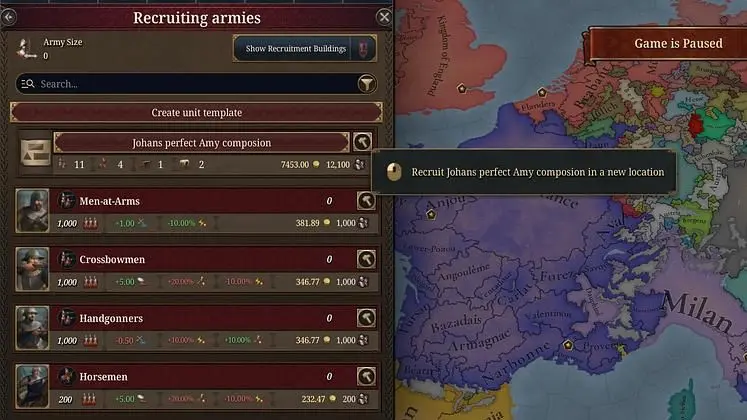
Paradox sold it as the patch’s “quality-of-life centerpiece”, and for once the promise holds. Unit Templates let you define a standard army composition — say 10 infantry / 4 cavalry / 6 artillery — and redeploy it anywhere on the map with a single click.
The change kicks in hard from the 17th century onwards, when your armies swell from 30k to 150k men. No more manually rebuilding each stack after a lost battle: you pick the template, the game reconstructs the army from available regiments, and Rally Points send reinforcements directly to the front.
It brings back the kind of fluidity that’s been missing since Hearts of Iron IV’s template system. The difference here is that Paradox adapted the concept to EU5’s tempo: more manual, closer to the ground, less automated. Exactly the right dose.
Peasant Enfranchisement: a novel social lever, but unpolished
This is the most ambitious feature of the patch. Peasant Enfranchisement lets you progressively grant rights to the lowest strata of your society — in exchange for lost influence with the nobility. On paper, it’s a social mechanic that’s unique in the genre.
In practice, after 20 hours of post-patch play, the verdict is mixed. The mechanic is genuinely interesting for players who want to simulate a transition toward a parliamentary monarchy or a bourgeois republic — Louis XIV’s France, for example, or the Dutch Republic. But the political cost is too low: once the nobility is unhappy, the negative effects are negligible if you’ve got a king with a decent Administrative stat.
The Paradox Plaza forum has opened several threads asking for a balance rework of the noble influence cost. Paradox added it to their roadmap for patch 1.2, but that patch focused on economy (Urban Rights) — so Peasant Enfranchisement stays as-is for now.
The Brandenburg disaster: historical immersion or clunky script?
Turmoil in Brandenburg is the new mid-game disaster introduced with Rossbach. It simulates the region’s 17th-century instability — chained revolts, internal religious conflicts, and external pressure from the Holy Roman Empire.
The intent is excellent. Players running Brandenburg (the future Prussia) needed a mid-game challenge to avoid the series’ classic Snowball drift. The disaster forces hard decisions — realigning religious policy, choosing between imperial protection and independence.
The problem is the trigger. Multiple players report the disaster firing without sufficient warning, even when internal stability looks fine. Others, conversely, have never seen the disaster trigger across 10 campaigns. Paradox confirmed a trigger adjustment is coming, probably in patch 1.2.1 or 1.3.
Regional reworks: the invisible groundwork
This is the part of the patch nobody talks about, and it’s a shame. Rossbach ships:
- A complete Manchurian rework: new representation of the Jin dynasty, scripted events for the Ming → Qing transition, balancing of the Jurchen tribes
- Economic refinements in the Andes and Mesoamerica: the Inca Empire and the Aztecs now have more coherent development bonuses, and Spanish colonial conquests are no longer trivial from 1500 onwards
- Several minor border corrections in East Africa and South India
These are the small gestures that keep a 300-year campaign coherent. If you play outside of Europe, Rossbach clearly improves the experience.
Bugs and hotfix 1.1.10: stability check
The March 5 launch came with a few notable bugs: a recurring crash during combined naval sieges, a display issue for Unit Templates in certain languages (French was affected), and a land pathfinding regression in the Balkans.
Hotfix 1.1.10 on March 17 fixed the majority. As of today, version 1.1.10 is stable. Two bugs linger: the template UI occasionally glitching in multiplayer, and slight map misalignment on ultra-wide screens.
Verdict after 60 days
Rossbach is not the revolutionary patch some were expecting, but it’s a solid consolidation update. Unit Templates alone justify a return to the game if you dropped out in late game. The other features (Peasant Enfranchisement, Brandenburg) are interesting additions that still need polish.
The real news is that Paradox held their pace: a major patch 4 months after launch, targeted at the real friction points the community reported. This is exactly what we hoped for after the chaotic opening months of November 2025.
Next up: patch 1.2 is already out, overhauling the global economy. And we already know 1.3 will lay the groundwork for the first paid expansions.
FAQ
When did the 1.1 Rossbach patch release?
Version 1.1.9, the first stable build of the Rossbach branch, launched on March 5, 2026 after an open beta that started on February 3. Hotfix 1.1.10 followed on March 17 to fix the most annoying bugs.What do Unit Templates do in EU5?
Unit Templates let you save a standard army composition (infantry/cavalry/artillery ratio) and reuse it anywhere on the map. No more 40 clicks to rebuild a stack — pick the template and regiments align automatically.What is Peasant Enfranchisement?
A new system that lets you grant rights to the peasant strata to stabilize your realm internally, at the cost of losing influence with the nobility. It's an unprecedented lever for players who favor a bourgeois or republican playstyle.Is it worth coming back to EU5 after Rossbach?
If you dropped the game because of heavy late-game micro-management, yes — Unit Templates and Rally Points radically change the comfort. If your grievance was balance or pathfinding, patch 1.1 doesn't fix everything.
- #Europa Universalis 5
- #EU5
- #Paradox
- Rossbach Patch
- Update
- Unit Templates