Table of contents
- Which origin to pick for your goal
- Why Prosperous Unification for beginners
- Scion, the Federations safety net
- Origins by playstyle
- Diplomacy and federations
- War: Clone Army
- Psionics: Teachers of the Shroud
- Story: Here Be Dragons
- Habitats: Void Dwellers and Shattered Ring
- Nomads, machines and hives
- Origins to avoid in a first game
- What changes with Willpower and 4.6
- Why old tier lists mislead
- Going further
For a first game of Stellaris, take Prosperous Unification: no DLC, no rules to learn and a richer start. If you own Federations and want a safety net, Scion is our second pick. No official ranking exists as far as we know, so this selection is a reading of the rules, sorted by playstyle.
The effects come from the wiki’s Origin page, verified for version 4.5. The game has been on 4.5.2 since 6 October 2026. You choose an origin when you create your empire, and that choice stays with it for the whole game.
Which origin to pick for your goal
The table sums up our picks. The order follows your intent rather than a power score, because the wiki does not rate origins.
| Goal | Origin | DLC needed | What it gives you |
|---|---|---|---|
| First game | Prosperous Unification | None | +400 pops, one extra district |
| Protected first game | Scion | Federations | A Fallen Empire as overlord |
| Simple game, new setting | Lost Colony | None | A parent empire of your species |
| War | Clone Army | None since 4.3.6 | Two clone vats, dedicated soldiers |
| Diplomacy | Common Ground | Federations | A federation from day one |
| Hegemony | Hegemon | Federations | The presidency of a Hegemony |
| Psionics | Teachers of the Shroud | Overlord | Psionic Theory and Latent Psionic |
| Story | Here Be Dragons | Aquatics | An allied dragon in your system |
| Habitats | Void Dwellers | Federations | Cheaper and larger habitats |
| Nomadic | Voidfarers | Nomads | The standard nomadic origin |
Why Prosperous Unification for beginners
The wiki gives it +400 starting pops and one district that depends on your empire. A settled empire receives a Generator District, a nomadic one Reactor Arrays. An organic species adds an Agriculture District, a machine or lithoid one a Mining District. A planetary modifier then lasts 20 years.
What matters is the absence of special rules. The wiki’s beginner’s guide calls it “always a good option” because its bonuses are simple. That section dates from 3.14, but the 4.5 origin entry is just as readable. Fantasy Warden ranked it first in its 3.12 list for the same reasons.
If you play without DLC and want a different setting, Lost Colony is the alternative that guide names. Your starting world is not your species’ cradle, and it loses the 30% habitability bonus. An advanced empire of the same species exists in the galaxy. Individualist empires begin with Colonial Spirit, Gestalts with Fresh Consciousness.
Scion, the Federations safety net
The same guide calls Scion “an excellent starting pick for new players”, in its section dated 3.14. You begin as the subject of a Fallen Empire, with a wormhole to its capital and +200 opinion both ways. According to the wiki, a fleet from that overlord can also help you in a war you are losing to a superior empire, once every 20 years.
Your ethics decide the overlord. Spiritualists get the Holy Guardians, materialists the Keepers of Knowledge, and everyone else a random roll. If the game has no Fallen Empire, a one-system empire is created. The origin excludes Fanatic Xenophobe, Gestalts, machine species and the Pompous Purists civic.
The risk is never learning to defend yourself. Fantasy Warden praises its starting position but finds the origin boring, and High Ground Gaming sums it up as fleets, leaders and a casus belli. We therefore recommend it for a second game rather than a first, if the previous one ended badly.
Origins by playstyle
Once you know the basics, choose by what you want to play. Each origin below comes with a trade-off, so read it before you start a long campaign.
Diplomacy and federations
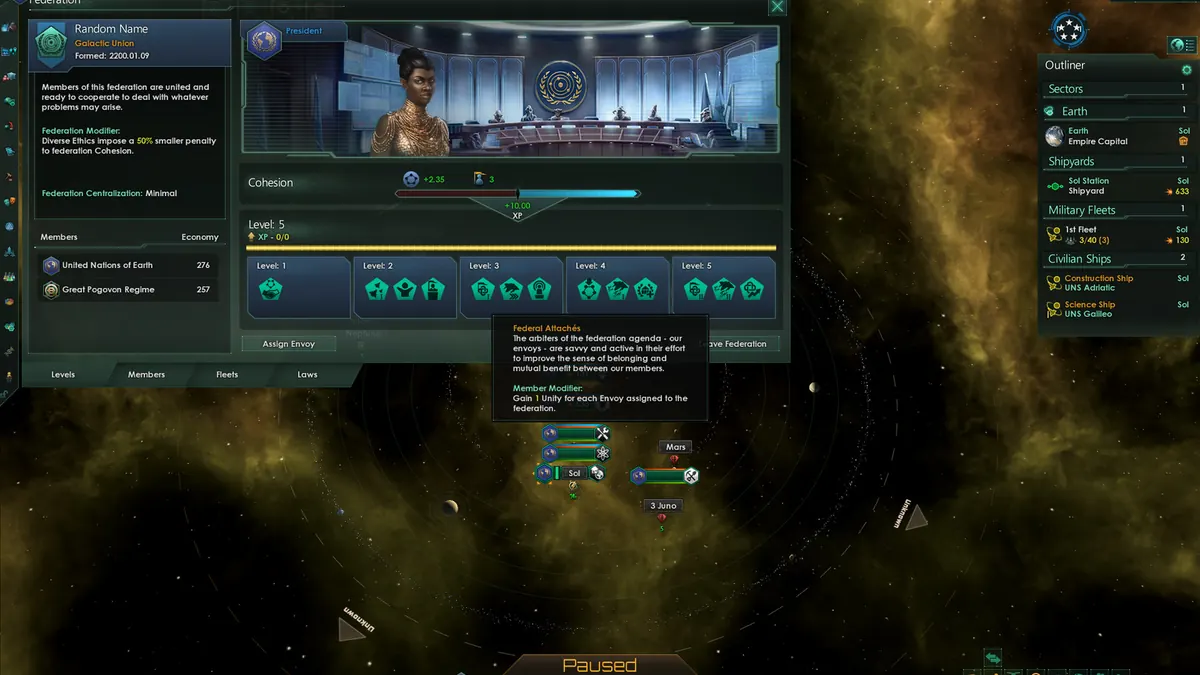
Common Ground puts you at the head of a three-member federation with 600 experience. You gain +100 permanent opinion, +50 trust and +70 intel with members. Hegemon offers the same base as a Hegemony, with only +50 intel. On paper, this is a reassuring start, but you begin with no assured habitable world nearby.
Xenophobes and genocidal empires are excluded from both, and Hegemon also refuses egalitarians. The wiki is our only detailed source for these two entries.
War: Clone Army
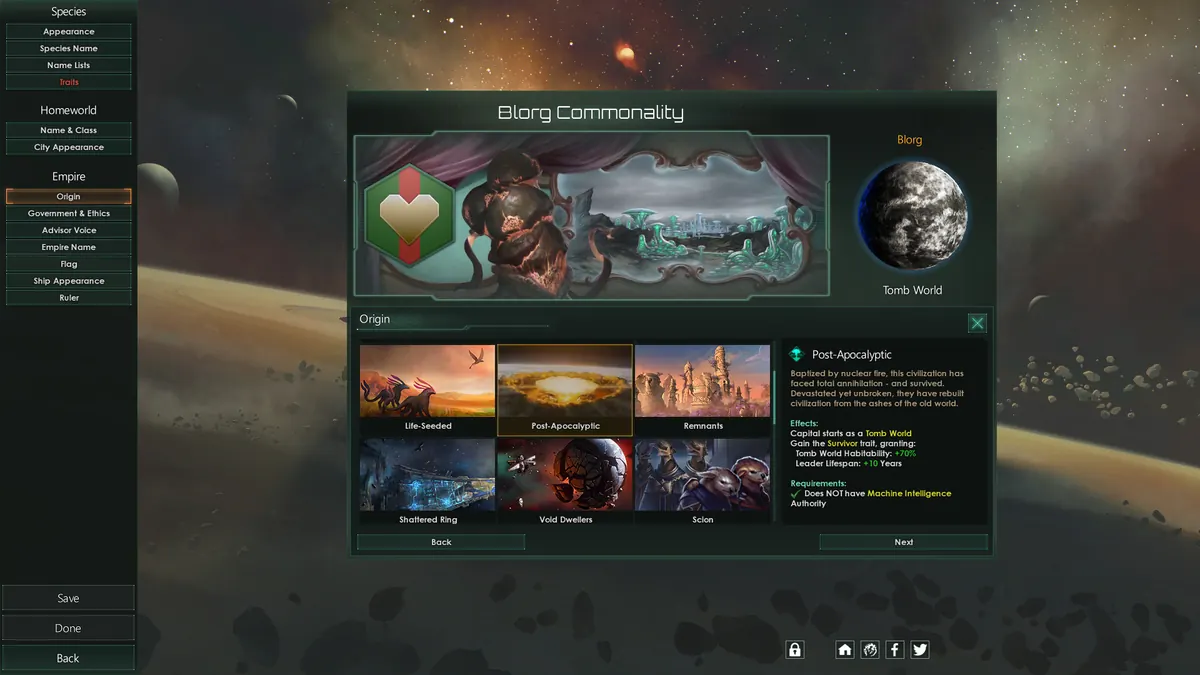
Clone Army starts with two Ancient Clone Vats, up to a maximum of five, and the Clone Soldier trait. Your clones are infertile and short-lived, and their commanders receive a dedicated trait. A dig site appears after 3 to 5 years and starts the Genetic Crossroads chain. Since patch 4.3.6 on 11 May 2026, Humanoids has been part of the base game.
Psionics: Teachers of the Shroud
This Overlord origin requires Spiritualist ethics. It gives Latent Psionic, Psionic Theory as a permanent research option and a start in contact with the Shroudwalkers, with 25 Rare Crystals. It also opens the Psionics tradition without the Mind over Matter perk. If you want psionics, this is the most direct shortcut in this selection.
Story: Here Be Dragons
An allied Sky Dragon guards your system, and a Living Metal deposit sits two hyperlanes away. Killing the guardian grants an empire modifier. A 2022 Steam thread describes it as a fun story origin with decent power, which remains one player’s opinion.
Habitats: Void Dwellers and Shattered Ring
Void Dwellers cuts habitat and habitat district costs by 20%, adds 2 maximum districts and gives 50% more jobs per habitat district. High Ground Gaming still flags food and planet suitability as weak points, and Fantasy Warden ranked it eleventh in 3.12. The risk for a first empire is high, because everything depends on your choice of systems.
Shattered Ring starts on a broken ring, with deposits of 5 Engineering, 10 Minerals and 10 Energy spread across its sections, the shattered world and the star. Like Void Dwellers, it excludes nomadic play and fixes your starting system.
Nomads, machines and hives
The Nomads Steam page names Voidfarers as the standard origin for nomadic empires. It brings a second Logistics Ship and +20% survey speed. Our nomadic empires guide covers this mode in detail.
Machine Intelligences can aim for Resource Consolidation, which starts on a machine world. Hives have Progenitor Hive, liked for its offspring, but fleets without an offspring ship lose 50% accuracy, evasion, fire rate and speed. The beginner’s guide advises new players against Gestalts anyway.
Origins to avoid in a first game
Some origins are interesting but too demanding when you are learning the game. Here are the ones we would keep away from a first empire.
- Galactic Doorstep. The beginner’s guide advises against it, because some outcomes spawn hostile fleets in your home system.
- Tree of Life. Worlds without the tree suffer -50% build speed, -25% resources from jobs and -5 stability.
- Doomsday. Your homeworld becomes a shattered world in 35 to 45 years, with a warning one year before.
- Fear of the Dark. The start removes 800 pops, in exchange for +10% anomaly discovery.
- Wilderness. The start removes 2,800 pops, on a size 18 world.
- Forever Cruise. The origin forbids settling, whatever your traditions.
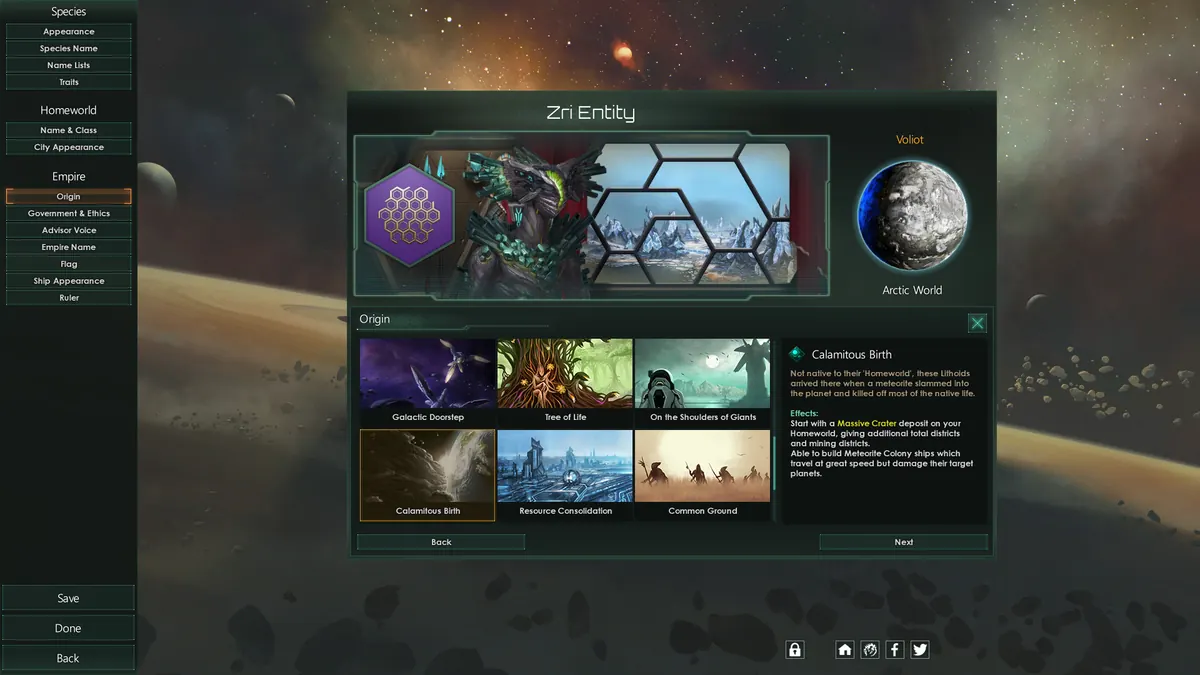
This Steam capture dates from the Federations release in March 2020. The interface and the origin list have changed since, and several effects are different.
What changes with Willpower and 4.6
Paradox has announced Willpower and the 4.6 “Corona Borealis” update for 23 November 2026. Dev diary 435 describes three new origins, to check in your own game after that date.
- Golden Generation. You train a class of students at the Golden Academy, then recruit them as leaders.
- Lost Makers. A Machine Intelligence searches for its creators, whose story is tied to an existing Precursor.
- Great Mosaic. You begin with one extra civic and no prescribed narrative path.
These origins require Willpower, and our release article sums up the rest of the expansion. Nothing allows us to rank them yet, because they were not out when this guide was written.
Why old tier lists mislead
The public lists consulted date from 3.12 or earlier, and none covers 4.5. The only Steam thread on 4.0 found has a single reply, recommending Evolutionary Predators for a conquest game. That signal is very weak.
Two examples show the wear. Older guides mention 4 pops for Prosperous Unification, while the 4.5 wiki counts 400. GameWatcher reported 64 years before Doomsday’s explosion in 2019, while the 4.5 wiki gives 35 to 45 years. Trust the effects shown on your empire creation screen.
Going further
Your origin often depends on the expansions you own, and our guide to the best Stellaris DLC compares them by price and reviews. To test an origin quickly, the complete console commands guide will help. All our coverage is gathered on the Stellaris page.
FAQ
What is the best Stellaris origin for beginners?
Our pick is Prosperous Unification. It needs no DLC, adds 400 starting pops and a district, and imposes no special rule. The wiki's beginner's guide calls it always a good option for that reason. If you own Federations, Scion is another way in, because a Fallen Empire protects you. Avoid Galactic Doorstep, which the same guide advises against for new players.Which Stellaris origins are available without DLC?
Prosperous Unification and Lost Colony need no DLC according to the wiki. Clone Army joined them with patch 4.3.6 on 11 May 2026, which rolled Humanoids into the base game. That patch also made Utopia and Synthetic Dawn free, and with them hive minds and Machine Intelligences. Check the empire creation screen for the exact list on your install.Can you change your origin during a game?
No. The wiki's beginner's guide lists the origin among the few permanent parts of an empire, along with the flag, the city and ship appearance, and ship prefixes. You therefore choose it when you create the empire. According to the wiki, an origin is kept when an empire switches between settled and nomadic. Try your ideas on a short game before you commit to a long campaign.Which origin should you choose for a nomadic empire in Stellaris?
Start with Voidfarers, which the Nomads Steam page presents as the standard origin for nomadic empires. The wiki gives it a second Logistics Ship, +20% survey speed and +20% arkship action speed. Forever Cruise, The Sacred Path and Heirs of the Khan forbid settling, which reserves them for a game where you accept that choice from the start.Are Stellaris origin tier lists still reliable?
Read them with care. The public lists found date from version 3.12 or earlier, before the 4.0 pop rework and the 4.3 balance pass. One example shows the gap: older guides mention 4 pops for Prosperous Unification, while the 4.5 wiki counts 400. They still help you understand how an origin works, but not read an exact rank in 2026.
Sources
- stellaris.paradoxwikis.com /Origin
- stellaris.paradoxwikis.com /Beginner%27s_guide
- stellaris.paradoxwikis.com /Downloadable_content
- store.steampowered.com /news/app/281990/view/668378128507209901
- store.steampowered.com /news/app/281990/view/670616610165229048
- store.steampowered.com /news/app/281990/view/679638395625932370
- store.steampowered.com /news/app/281990/view/668378128507208705
- store.steampowered.com /app/1140001/Stellaris_Federations/
- store.steampowered.com /app/4241420/Stellaris_Nomads/
- gamewatcher.com /stellaris-federations-doomsday-origins
- fantasywarden.com /games/stellaris-origins
- highgroundgaming.com /stellaris-best-origin/
- #Stellaris
- #Paradox
- Guide