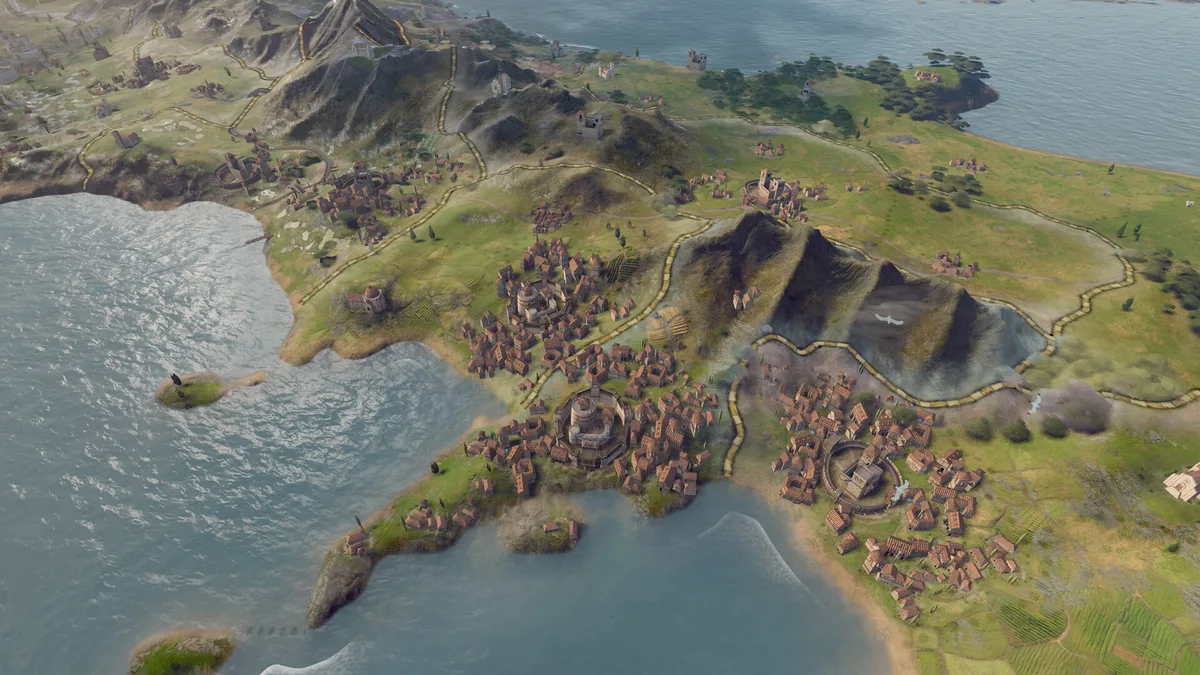
Silk & Silver arrives on 17 November, and trade becomes a system
Paradox dated Silk & Silver on 19 October 2026: the Crusader Kings III expansion launches on 17 November on PC. It costs 29.99 EUR (USD 29.99 or GBP 25.99) on its own and is part of the Chapter V pass, priced at 43.99 EUR. One outlet reports 19 November, but Paradox’s official announcement and several other outlets give the 17th. The expansion lands only weeks after By God Alone, released on 30 September.
This article reads the official announcement and the seven Dev Diaries published since April. It answers one question: what does trade really change in a game of CK3? The text relies on Paradox’s documentation, not on a played build. The Dev Diaries themselves warn that content could change before release.
One market per duchy: the new economic layer
Dev Diary #2 describes the foundation of the system. The world holds more than 900 trade markets, one per de jure duchy. Each market sits in the capital barony of its duchy and serves every holding in the area. It tracks the production and needs of those holdings. What stands out is that the duchy map becomes an economic map.
More than 40 trade goods are scripted. Buildings express their needs by category: a building that wants cereals accepts wheat, millet or rice. Once a month, each market calculates what it produces and what its buildings consume. Routes then propose buying one market’s surplus to sell it in a market running a deficit. On paper, the loop is simple; in practice, everything depends on the balance between production and needs.
For a landed ruler, trade is mostly something that happens to them. Dev Diary #5 explains that the old acquisition routes become distribution routes: a duke or higher can link two markets whose capitals they hold and exchange basic goods. Merchants and republics keep the rarer products and the leftovers. For players running a duke or a king, this change matters.
In Dev Diary #2, competitiveness settles disputes. When several routes sell the same good in a market, each gets a share proportional to its score. Without a monopoly, nobody has exclusivity. Wars, plagues and building changes shift these numbers every month, so routes need watching rather than forgetting. The real issue is vigilance, but the system rewards whoever adjusts.
The landless merchant: a new government type
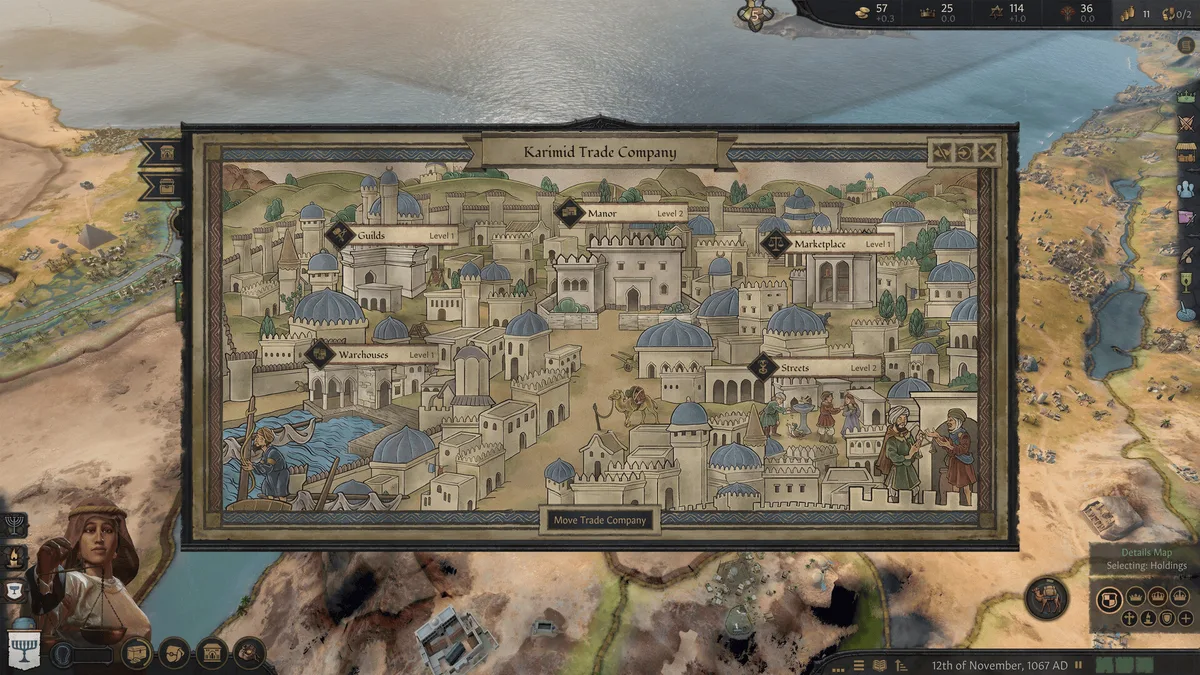
The official announcement presents the Merchant as a landless family leading a trading company. Three specializations exist: the Caravaneer moves large quantities of goods, the Creditor lends money to rulers, and the Artisan creates new artifacts. Progress runs through the Trade Expertise of a goods category, which stays attached to the title and so survives succession. What matters is the slowness: expertise is built over several generations.
In Dev Diary #2, Acumen measures the merchant’s business sense. It grows with the profit actually collected, not with the volume moved. The real issue is profitability, not tonnage. Monopolies are granted by the holder of the market’s capital. A normal monopoly respects local needs; an exploitative monopoly also draws on local demand, at the market’s expense.
Dev Diary #6 adds commission routes: rulers offer contracts to fill a need between two markets. A merchant can hold up to four, depending on company size. They last 10 years, with a sum paid upfront. Cancelling a contract costs money and can earn the “Dealbreaker” fame trait.
In Dev Diary #6, each route has a Trader, picked from relatives and associates. The player decides whether that Trader improves competitiveness, expertise in the primary good or route capacity. While the route runs, the Trader travels from market to market and carries out small schemes. Traders can also be poached from other companies. The company has a domicile, the merchant’s mansion, upgraded with gold and prestige to open new routes. The risk, on paper, is a chore repeated for every route.
Republics: patrician city-states
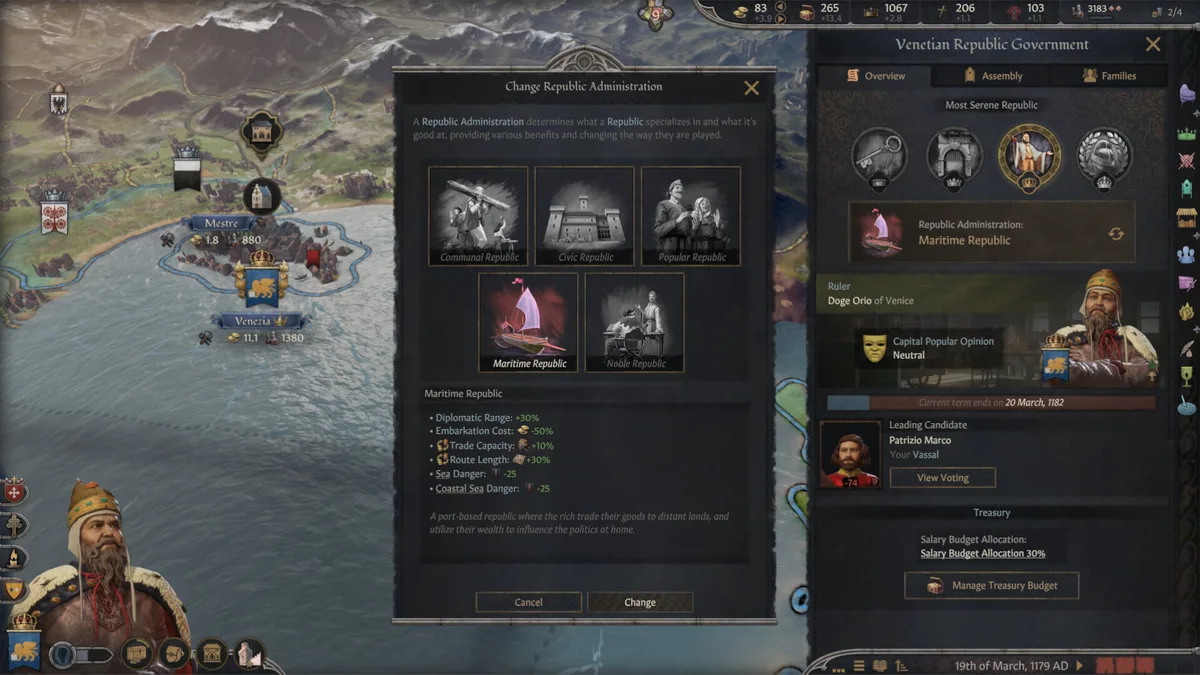
Dev Diary #4 defines republics as small city-states. The ruler and every patrician of the town count: they are landless nobles and burghers who sit in the assembly and may aim for the head of the city. Venice, Florence, the Swiss cantons and the free cities of the Holy Roman Empire serve as inspiration. The Vatican is also split from the city of Rome.
A county-tier city can only sustain one family and has limited laws. It becomes a true republic only at duke tier, when other families join. House ambitions define each family’s idea of the city, and popular opinion weighs more than for other landed governments. A hated ruler faces consequences, even to their health.
Politics runs through the Assembly. Any member can propose a law change, and the vote lasts six months. Who sits, what majority is needed and what the assembly can vote on are themselves laws. The default succession is election, as in the Holy Roman Empire, with the option to slide toward despotic succession.
Decrees are decisions specific to republics, paid from the government treasury and subject to the assembly. The Trade Post is a new district held in someone else’s lands, inspired by Hanseatic Kontore and Italian fondachi. Every county in the world can host one. Trade Post buildings raise sell prices, negotiate an alliance with the local ruler or recruit local men-at-arms. A new mercenary limit also stops wars from being won by wealth alone.
Trade leagues and Guelphs versus Ghibellines
Republics can form trade leagues, confederations that pool their resources and monopolies. Dev Diary #4 presents them as a long-term goal, with the Hanseatic League as the model. Dev Diary #7, published on 20 October, details their outline alongside the Italian traditions.
It also introduces the Guelphs & Ghibellines Situation, which pits the papal party and the independence of Italian cities against the imperial party. Six phases pace it: Papal Resurgence, Dictatus Papae, Repose, Agitation, Guelph Advantage and Ghibelline Advantage. A side enters an advantage phase at 70% power and leaves it below 60%.
The Situation offers three endings: Guelph victory, Ghibelline victory or compromise. A Guelph victory makes the imperial vassals of northern Italy independent. A Ghibelline victory attaches Italy and Romagna de jure to the Empire. Two new bookmarks come with the content: 1066 “Channels of Commerce” and 1178 “Guelphs & Ghibellines”.
The player acts through schemes: replace a ruler, claim party leadership, rally the undecided or coax a defection. Civic carnivals celebrate the greatness of the republic. In 1075, the Investiture Controversy plays out as an event; in 1123, the Concordat of Worms. From 1167, a future Italian city-state can break free and join the Lombard League.
What the expansion does not do
No naval warfare comes with the expansion. Dev Diary #1 says so plainly, and Paradox explained that adding naval battles would have disrupted its schedule. For maritime republics the absence is notable: Venice without a combat fleet remains a stated design choice.
On paper, the risk lies elsewhere. Dev Diary #5 describes the iteration phase as the one where everything is assembled: distribution routes have already replaced acquisition routes. Figures quoted in the Dev Diaries may therefore still move, and the balance of monopolies and competitiveness will only be judged in a real campaign.
Which player is it for
In practice, the expansion targets two profiles. The first likes economic systems: routes, needs, monopolies and expertise form a loop that rewards patience across generations. The second likes city-state intrigue: assembly, laws, rival patricians and leagues offer an internal politics game without large conquest.
For a player of large feudal monarchies, the contribution is more indirect. Markets touch every ruler, but most of the levers benefit the merchant and republican governments. The 29.99 EUR price should therefore be judged by the appetite for playing those two governments.
Going further
Sources
- store.steampowered.com /news/app/1158310/view/701030583835296543
- store.steampowered.com /news/app/1158310/view/552395313313219181
- store.steampowered.com /news/app/1158310/view/690882808486299147
- store.steampowered.com /news/app/1158310/view/677374546802640260
- store.steampowered.com /news/app/1158310/view/687515256220549925
- store.steampowered.com /news/app/1158310/view/711160422578783398
- store.steampowered.com /news/app/1158310/view/701030583835296280
- gamingtrend.com /news/crusader-kings-iii-silk-silver-turns-medieval-merchan…
- gamingonlinux.com /2026/10/crusader-kings-iii-silk-silver-expansion-arrives-n…
- gamingonlinux.com /2026/04/crusader-kings-iii-gets-a-new-major-patch-and-chap…
- paradoxinteractive.com /media/press-releases/paradox-interactive/paradox-launches-…
- store.steampowered.com /app/4232910/
- #Crusader Kings 3
- #Paradox
- Silk Silver
- #DLC 2026