Table of contents
- By God Alone is more than a “play the Pope” mode
- Free or paid: how 1.20 is split
- Spiritual Fulfillment: a gauge for every character
- The Christian Church Situation: a moving calendar
- The Investiture Controversy: who appoints your bishops
- Puppets, theocracies and the College of Cardinals
- The Great Schism, now tracked and playable
- After launch: four patches in three weeks
- Which player is it for
- Going further
By God Alone is more than a “play the Pope” mode
Crusader Kings III received By God Alone on 30 September 2026, alongside the free 1.20.0 “Crozier” update. The expansion costs 19.99 EUR (USD 19.99 or GBP 16.99 depending on region) on its own, or comes as part of the Chapter V pass. Paradox’s launch messaging leads with playable theocracies: archbishops, patriarchs and the Pope. That is the obvious hook, but it hides what matters most to the majority of players.
This article reads the official launch changelog and the expansion’s Dev Diaries to answer a simple question. What changes in an ordinary Christian playthrough, without playing the clergy? The text relies on the publisher’s documentation, not on a played campaign: every mechanic cited comes from an official source.
Free or paid: how 1.20 is split
The first point to clear up, because it affects the purchase decision. The 1.20.0 changelog separates an “Expansion Features (Paid)” section from a “Free Features” section. The free part holds Rites: every faith branch or school becomes a Rite, with its own Divergence and head. It also holds the reworked excommunication, Monastic and Military Orders, Eminent Holy Sites, and Personal Tenets with Spiritual Fulfillment.
The paid part covers the Situation of the Church, playable theocracies, the College of Cardinals, Puppets, Ecumenical Councils, the Grand Cathedral and the tracked Great Schism. Paradox’s press release, however, lists Spiritual Fulfillment among the expansion’s features. The detailed changelog is the reference for the exact scope, but the gap deserves a check on Steam before buying.
Spiritual Fulfillment: a gauge for every character
Dev Diary #1 presents Spiritual Fulfillment as a new character metric running from -100 to +100. It compares the life the character leads with the life their faith asks for. Living up to a virtue raises it, acting on a sin lowers it, with a weight specific to each virtue and sin.
For Christian characters, the gauge breaks into seven named tiers. At the very bottom, the “Doomed” tier (-95 and below) raises stress gain sharply but also lifts some brakes: murder schemes no longer generate stress. The frame is set: being a good ruler and being a good believer no longer always go together.
The changelog adds 26 new Tenets, among them Transubstantiation, Simony, Purgatory, Confession and Miles Christi. A character can adopt beliefs of their own, separate from their faith’s Core Tenets. A Tenet prohibited by the faith creates a secret. Decisions such as “Take Confession” or “Receive Last Rites” restore Fulfillment. The new Tenets stay limited to Christians, but Personal Tenets exist for every religion.
The Christian Church Situation: a moving calendar
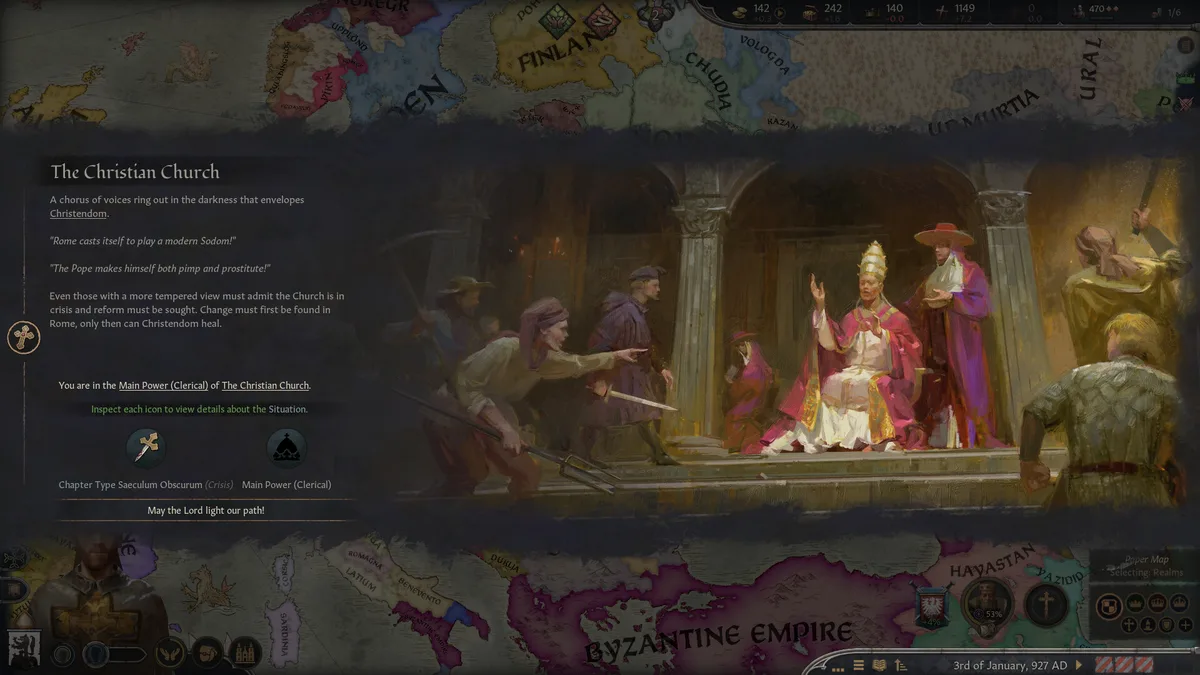
The core of the expansion is the Christian Church Situation. Dev Diary #4 describes this system as a system tracking the spiritual health of Christendom across seven Chapters. Every Christian ruler of County tier or above takes part, sorted into one of six groups depending on whether they are clerical or secular, main power, secondary power or heretic.
The seven Chapters are Fragile Unity, Saeculum Obscurum, Conversion, Reform, Investiture Controversy, Crusade and Concord. Each belongs to a type (Stability, Zeal, Instability or Crisis) and applies different modifiers by group. Catalysts push the Situation forward: clerical marriage, simony, murdered prelates, holy wars, antipopes, councils or Grand Cathedral contributions. A Chapter takes over once it reaches 1,000 points.
In practice, the player is not a passive spectator. The “Guide the Christian Church” decision, available every ten years, triggers a Catalyst of your choice. For a Head of Faith the effect is four times larger. It runs for the whole game once the expansion is owned, Dev Diary #7 specifies.
The Investiture Controversy: who appoints your bishops
The Investiture Controversy is one of the seven Chapters, detailed in Dev Diary #5. Christian religions start with the Conditional appointment doctrine: neither the ruler nor the clergy need permission to appoint a cleric in their jurisdiction, and either side can react immediately.
Replacing a court chaplain is cheap. Replacing the holder of a clerical title is much costlier: the “Meddling in Clerical Appointments” modifier applies, and the whole clergy likes you less for a decade. These moves feed the Situation up to the Chapter’s threshold.
When the Controversy begins, a 30-year countdown opens. It ends with the Investiture Council, a special ecumenical assembly. The clergy vote between the “Spiritual, Revocable” and “Temporal, Revocable” doctrines. By default, the clerical vote goes to the spiritual side. The secular player can tip it through puppets, through the Investiture Conflict casus belli or by paying Piety for sway attempts. If the temporal side wins, the Situation returns to Fragile Unity; otherwise it moves to Reform.
Puppets, theocracies and the College of Cardinals
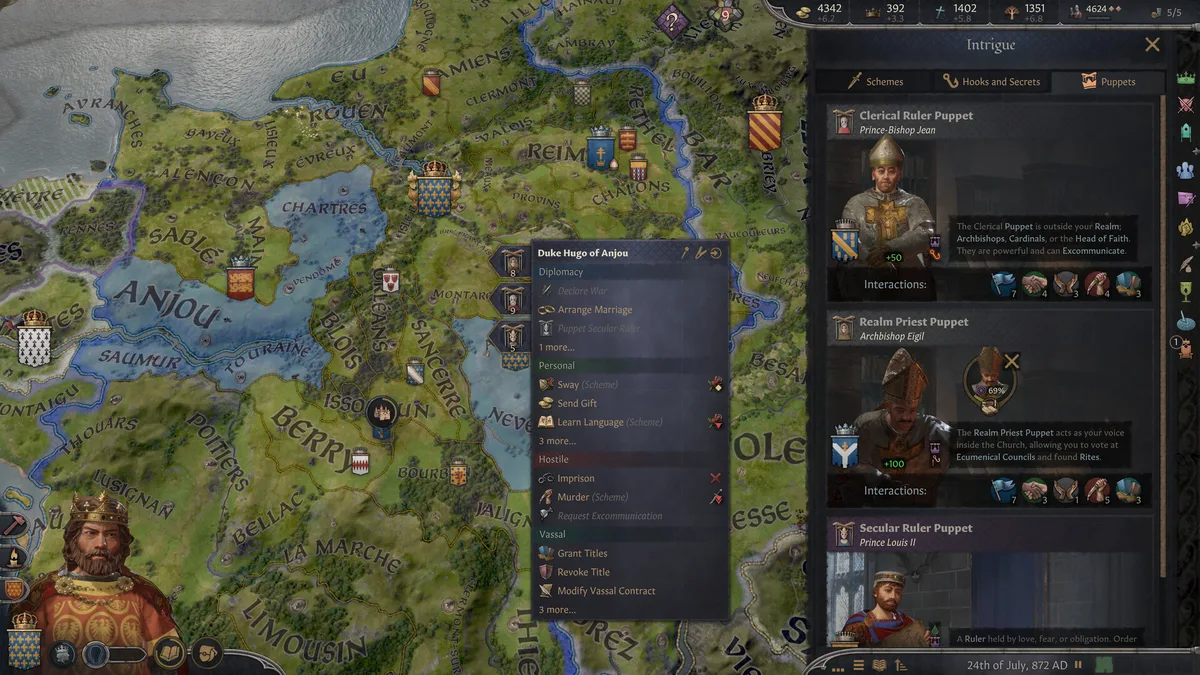
The Puppets system gives the secular player a lever over the clergy. A Puppet is a real character who acts in your place, as Dev Diary #3 explains. The changelog lists three types: the court chaplain, a cleric from outside the realm and a coerced secular ruler. Costs and refusals fall on the Puppet, not on you.
Available actions cover excommunication, holy sites, faith creation, cardinal appointments, conversions, wars, alliances and marriages. A concrete example appears in Dev Diary #7: place a kinsman as chaplain, request a cardinalate for him, then spend Piety to raise his Papabile score.
On the theocracy side, Theocratic and Ecclesiastical rulers become playable, with their own government, succession and a Church Treasury. The College holds up to 70 cardinals. Papal Bulls can permit or forbid a Tenet for the whole faith, declare a Rite heretical or proclaim the Age of Crusades.
The Great Schism, now tracked and playable
According to Dev Diary #7, the Great Schism is not a Chapter but a second progress track on the same Situation. It advances through Ecumenical Councils, crossings between Rites, excommunications and conversions in Holy Site Counties. The changelog states that progress never decreases.
Three decisions exist, all tied to the Saeculum Obscurum Chapter and a threshold: cause the Schism, prevent it, or mend it through diplomacy. A Crisis Chapter only triggers it if the threshold has been met. Once the Schism has occurred, Chalcedonianism cannot return as a unified faith, and mending it goes either through conquest, which requires holding the five old Patriarchal Sees, or through diplomacy.
After launch: four patches in three weeks
Paradox has shipped a series of fixes. Update 1.20.0.3 (1 October) repairs, among other things, a block on elective titles and a crash in the Fourth Crusade story. Update 1.20.0.4 (6 October) fixes an artifact interaction. Update 1.20.1 on 13 October is a genuine balance patch. The cost of “Canonize a Saint” rises from 2,000 to 3,000 Piety, the Scholar lifestyle XP bonus is halved, and Council debates gain an AI opponent.
Update 1.20.1.2 on 21 October is a small bug fix, compatible with 1.20 saves and mods. The logical next step is gradual balancing. The risk for anyone buying now is meeting costs that are still being adjusted from one patch to the next.
Which player is it for
On paper, the content is massive. For a player of Christian dynasties, the value rests on three things. The Situation gives the Church’s history a rhythm. The Investiture Controversy makes appointments contested. Puppets give the secular ruler a lever no other expansion offered.
For anyone who mostly plays outside Christendom, the direct contribution is small: the Situation and the College only concern Christianity. Rites and Personal Tenets, for their part, arrive through the free update. The risk remains: an expansion this dense takes time to learn, and Council debates already received an AI opponent in 1.20.1.
Going further
FAQ
Has CK3 By God Alone been released?
Yes, the expansion launched on 30 September 2026 on PC, alongside the free 1.20.0 Crozier update.How much does By God Alone cost?
19.99 EUR (USD 19.99 or GBP 16.99) on its own, or included in the Chapter V pass.Do I need the expansion to enjoy 1.20?
No: Rites, the reworked excommunication, Monastic and Military Orders and Personal Tenets are in the free update according to the changelog.
Sources
- store.steampowered.com /news/app/1158310/view/684140727200907281
- store.steampowered.com /news/app/1158310/view/526500154372522963
- store.steampowered.com /news/app/1158310/view/653728746655712389
- store.steampowered.com /news/app/1158310/view/717908211952259626
- store.steampowered.com /news/app/1158310/view/702151321303646672
- store.steampowered.com /news/app/1158310/view/716790555855553453
- store.steampowered.com /news/app/1158310/view/684141361612459298
- store.steampowered.com /news/app/1158310/view/701031128264343884
- store.steampowered.com /app/4232900/Crusader_Kings_III_By_God_Alone/
- paradoxinteractive.com /media/press-releases/paradox-interactive/call-on-higher-an…
- #Crusader Kings 3
- #Crusader Kings Iii
- #By God Alone
- #DLC
- #Paradox
- Theocracy
- Spiritual Fulfillment