Table of contents
- Where Manor Lords stands on October 26, 2026
- Active Recipes: a priority queue instead of a single focus
- Cows, oats and animal feed: a winter trade-off
- Cheese, cider and mead: chains tied to the village tier
- The Construction Yard and advanced structures
- Wide Valley and the rest of the patch
- What the later betas have already changed
- Verdict: what matters
- Going further
Manor Lords’ Production Focus had a specific flaw: it pointed a workshop at a single production at a time, with no priority order. Major Update #8 replaces that setting with Active Recipes, then builds cows, cheese, cider and mead around it. The patch reached the beta branch on August 1, 2026, and landed on the main branch on August 27. This analysis rests on Slavic Magic’s official notes and specialist press coverage, not on personal hands-on play.
Where Manor Lords stands on October 26, 2026
Beta 0.8.097 appeared on Steam on August 1, 2026. Fixes followed until the main-branch release, announced by the studio on August 27 under the title “Major Update #8: Wide Valley, Cows, Cider, Advanced Construction & More”. The notes cover versions 0.8.090 to 0.8.104.
Events have moved past the summer beta. Manor Lords reports more than four million copies sold across all platforms, and the studio has already published a 0.8.110 beta on September 27 and a 0.8.117 beta on October 24. Both rework farming, which feeds the very chains described here. The beta password that circulated in August no longer matters for this content, since it now ships in the main game.
Active Recipes: a priority queue instead of a single focus
According to the official notes, Production Focus only let artisans aim at one production at a time. Active Recipes let players choose the order in which productions run. Artisans start with no active recipe, so the player has to set them.
Here is what this changes for day-to-day management:
- A workshop that can make several goods now follows an explicit order instead of a single setting.
- Priority becomes a design choice for the whole chain, to be revisited when the village’s needs change.
- The rival AI now also selects a production focus for its artisans, according to the same notes.
PCGamesN and GameLuster both describe the change as finer priority control for artisans. The real gain is readability: someone running a sawmill, a forge and a brewery in parallel no longer has to redirect one focus whenever a stock comes under pressure.
Seasonal assignments complete the picture. A building can automatically cycle its assigned families from one season to the next. That saves reassigning families by hand at every change of season.
One question remains open. The notes do not say what happens when an ingredient runs out in the middle of the queue: does the workshop wait, or move on to the next recipe? On a long chain such as milk, salt and then cheese, the answer changes how stocks should be organized. This uncertainty is the main point to watch for players building large production chains.
Cows, oats and animal feed: a winter trade-off
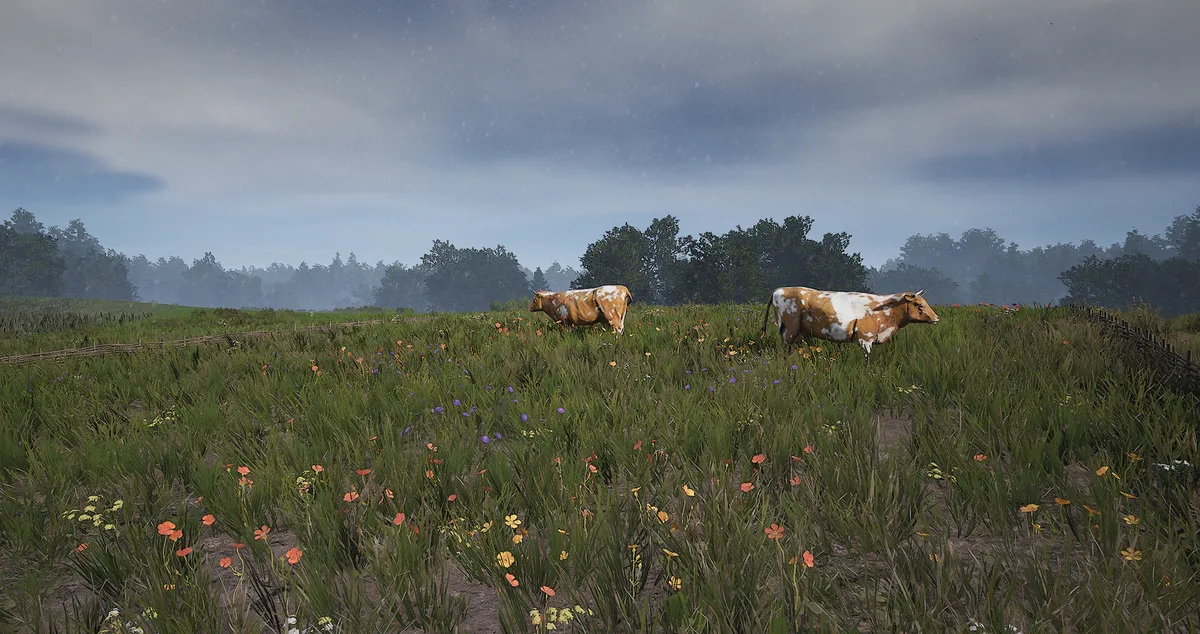
Cows are imported through the Livestock Trader. They provide milk passively and can be butchered for beef and hides. Calves also arrive, and the notes specify that calves and lambs yield half as much as adults at the butcher.
The defining constraint comes in winter. Cows and sheep get hungry and consume animal feed every month, or they die. That feed is crafted from oats, a new crop that shares barley’s fertility while being more resilient. The official notes give a ratio of 1 oats for 2 feed, made at the Livestock Farm, formerly called the Sheep Farm.
Oats can also be eaten directly by the population. That double use forces a choice the old system never imposed: reserve fields for villagers’ food, or feed the herd through to spring. Pastures also need 2.2 times the area for the same pasture space, the studio says, which puts pressure on available land.
Seasonal rhythms reinforce this logic:
- Cows breed in summer and sheep in autumn, with offspring arriving in spring.
- Sheep can only be sheared once a year, in summer.
- Cows are milked monthly, except in winter.
Milk therefore arrives in windows rather than as a continuous flow. For players, this turns livestock into annual planning rather than simple passive production.
Cheese, cider and mead: chains tied to the village tier
The Cheesemonger unlocks at Burgage Plot level 3 and makes cheese from milk and salt. Putting cheese behind a village tier and an extra resource to produce, salt, creates a supply-chain decision in the mid-game. Cheese is not something to start in the first few months.
The brewery gains two recipes. Cider is made from apples, at 4 apples for 1 cider in the studio’s announcement, and mead from honey at 1 to 1. Honey in turn depends on apiaries, which were reworked: they are now seasonal, accumulate yield through spring and summer, then are harvested in autumn. Their output depends on the Wilding affinity and the meadow environment.
The same notes adjust fruit balance: apple cost rises by 23%, pear cost by 11%, and fruit yields drop by roughly 10%. Launching a large cider chain therefore takes more investment than before. The new drink logic also means families will no longer drink a beverage that does not match their distribution, nor in a tavern with no assigned workers.
The interest of these chains lies in their interdependence. Milk depends on livestock, so on oats, so on fields. Cider depends on orchards and mead on apiaries. None of this is an isolated content addition: each product weighs on another.
The Construction Yard and advanced structures
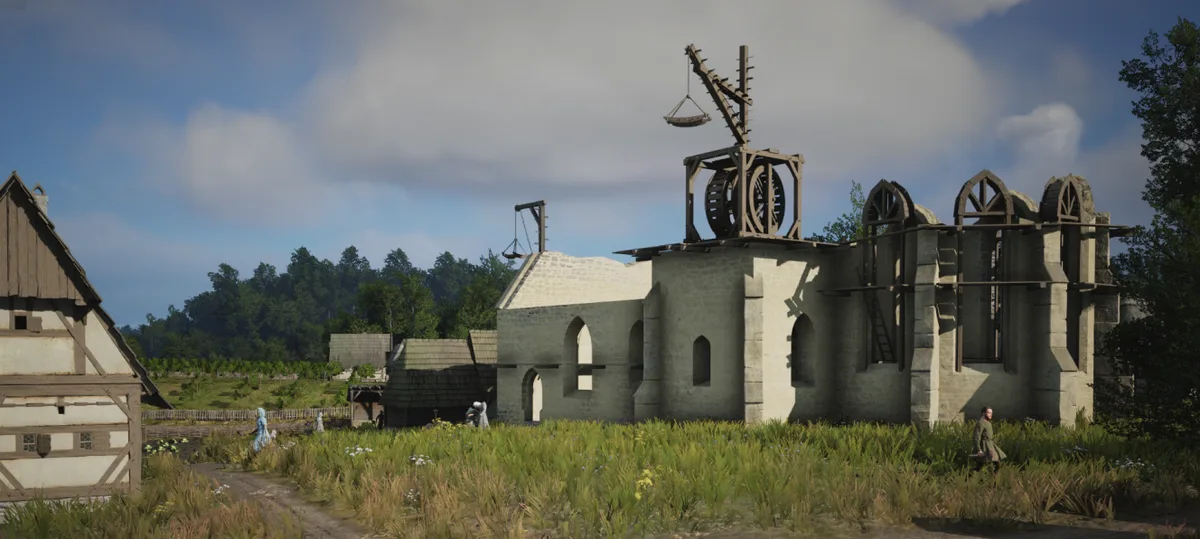
The patch also adds a Construction Yard. Workers store construction material there and distribute it to building sites by handcart, which improves logistics. Construction runs 50% faster when the Construction Yard is properly maintained, per the announcement and two press articles that repeat it.
Oxen assigned to the Construction Yard use a new ox cart that can carry timber in bulk. Some buildings become advanced structures: they need professional builders assigned to the Construction Yard. Unassigned families still help with transport and basic tasks such as flattening the ground. An upgrade, the large stone church, joins them.

Wide Valley and the rest of the patch
The new Wide Valley map is described as a river map. It is too early to say which mill or fishing locations will be optimal there: none of the sources consulted documents it. The map matters mostly as a starting ground for trying the new chains on a fresh settlement.
The patch also includes a reworked main interface, storage filters on Trading Posts and many AI adjustments. The announcement also notes a broad rebalance: construction times generally lengthened, vegetable yields cut by about 30%, rye yield cut by 12.5%.
What the later betas have already changed
Beta 0.8.110, released on September 27, adds six Rural Foundations perks, a Dunghill and fertilizer production from animal dung. It makes crop rotation mandatory and officially separates winter and spring crops. Wheat and rye are winter crops, while flax, barley and oats are spring crops, according to the specialist press.
This directly touches livestock: animals produce dung, which feeds the fields, which produce the herd’s oats. The loop closes. Beta 0.8.117 of October 24 further tweaks field fertility and rye, according to the official notes. Both versions remain betas according to the Steam announcements consulted, so the final behavior is still to be confirmed.
Verdict: what matters
Active Recipes is a targeted improvement, not a revolution. It tackles a real problem of conflicting priorities in workshops. The new chains add decisions that depend on the stage of the game: cheese requires level 3, mead requires apiaries, and oats force a choice between humans and animals.
The real issue remains readability. As the number of interdependent resources grows, a workshop’s queue has to stay clear to remain useful. The notes for Major Update #8 add a dedicated help button for Active Recipes and help pages on pasture animals. For players who set Manor Lords aside for lack of new content, that is a serious reason to start a fresh settlement, preferably on Wide Valley.
Going further
- The complete Manor Lords guide covers the city-builder basics before diving into these new chains.
- The wider early-access context is in the two-year Early Access review.
- All coverage of the game is gathered on the Manor Lords page.
Sources: Steam — Major Update #8 · Steam — beta 0.8.097 · Steam — beta 0.8.110 · Steam — beta 0.8.117 · PCGamesN · GameLuster · CogConnected · SimulationDaily
Sources
- store.steampowered.com /news/app/1363080/view/696519918583023238
- store.steampowered.com /news/app/1363080/view/678507423258904140
- store.steampowered.com /news/app/1363080/view/696524994028504823
- store.steampowered.com /news/app/1363080/view/683016729753819026
- pcgamesn.com /manor-lords/update-august-2026-beta
- gameluster.com /manor-lords-update-0-8-097-cows-construction-tiers/
- cogconnected.com /2026/08/manor-lords-celebrates-4-million-sales-with-a-huge…
- simulationdaily.com /news/manor-lords-0-8-110-beta/
- pcgamer.com /games/city-builder/manor-lords-celebrates-4-million-copies…