
Table of contents
To colonize in Europa Universalis 5, explore the area first, then open a colonial charter on a province within your colonial range, and let your settlers migrate until they reach the required threshold. Speed depends mostly on colonial migration, not on your fleet. This guide is current for the 1.4 Rio Salado update released on 28 October 2026, which adds charter goals.
In practice, EU5 colonization is about population before ships. Pops actually leave your homeland to settle the new land, so every colony is paid for with people.
Any country can colonize, from Portugal to the Ashikaga shogunate, especially after the Age of Discovery and the New World institution. Paradox also offers a game rule that limits AI colonization to European nations, without affecting Steam achievements.
Step 1: explore Terra Incognita
Each country only sees the areas it has discovered. The rest shows as Terra Incognita, which you explore from the Geopolitics tab, according to Developer Diary #4. An exploration costs gold plus sailors at sea, or manpower on land. It also needs a character to lead it.
The official wiki notes that duration depends on the distance to your capital and on terrain. A longer naval range and a skilled leader shorten the voyage. The wiki lists a cost of 100 gold and 250 sailors or manpower, then 10 gold of monthly upkeep, with 270 days of preparation that the leader’s diplomatic skill reduces. Paradox adds that preparation consumes lumber, naval supplies and liquor: without those goods in the port’s market, it stops.
Monthly progress starts at 0.05. The Age of Discovery, which begins in 1437, adds +0.25 according to the wiki’s Age page. What matters: launch your explorations as soon as that age begins, when the bonus multiplies your speed.
Another trap flagged by Paradox. Land is revealed only when the expedition returns home, not during the voyage. An expedition lost at sea brings back nothing, despite the gold and sailors committed.
Step 2: open a colonial charter
Once the area is discovered, the Colonization tab lists the available charters. A charter targets a whole province and completes when every location in it is colonized. It can only target land within your colonial range, which advances increase.
You pay for it in three ways.
- Up front. A sum of gold to create the charter.
- Every month. Upkeep that depends on local population, distance to the capital and colonial maintenance efficiency.
- In goods. The wiki lists cloth, salt, medicaments, weaponry and tools drawn from your market.
The wiki gives a 12% upkeep reduction for each active charter beyond the first, capped at 7 charters. The Age of Discovery adds -25% colonial maintenance. On paper, running many charters is cheaper per charter. In practice, every extra charter also splits your settlers, so each one fills more slowly.
Step 3: move your settlers
Every month, pops of your primary religion and of your primary or accepted culture leave the homeland for the charter. You choose the province they leave from. Since patch 1.3, migration can come from any region linked to the capital by land or strait.
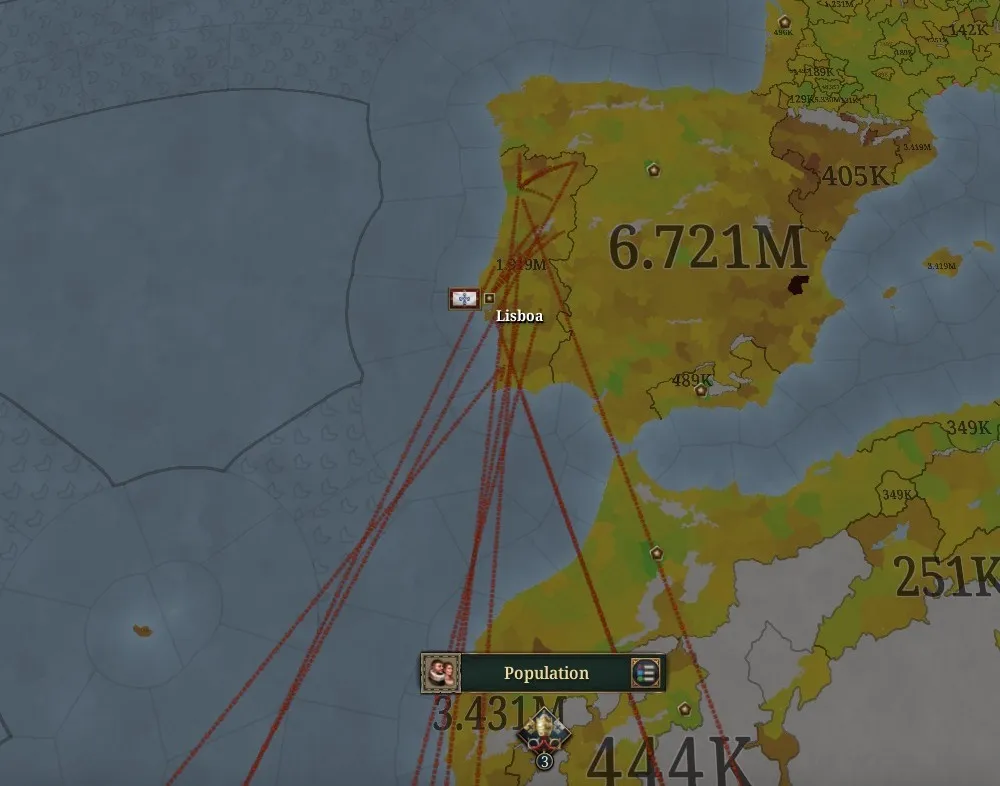
Colonial migration rises with advances, laws and the Outward societal value. It falls with Inward, distance and the province’s vegetation, according to the wiki and the developer diary. Patch 1.1 halved it and made it more costly.
If you play a colonial power, push Outward as soon as it appears with the Age of Discovery. It is the most direct lever on colonization speed.
The real cost: native population
The settler threshold is at least 1,000 per location, and it climbs with the native population. The wiki gives the formula: with 5,000 natives, you need about 2,400 settlers. With 20,000 natives, you need nearly 6,600, and the calculation caps at 50,000 natives. Power projection lowers the threshold, but only slightly: going from 0 to 100 saves 8.3% of the settlers on a 5,000-native location, per the same page.
Paradox adds that malaria, a harsh climate or little arable land slow colonization down. The risk is opening a charter on a crowded province early on, while a sparsely populated coast fills much faster.
Resources should guide the choice too. Each location has a fixed output: gold, sugar, furs, cocoa. The developers point to Portugal in Brazil for gold and gems, and Spain in Mesoamerica.
Colonial races and the partition treaty
A charter does not grant exclusivity. Several countries can target the same province, and the first to finish wins it. The wiki states that the loser gives up prestige, gold or government power. The losing settlers stay put, according to Paradox, which produces colonies with mixed populations.
Between two Catholic countries, the race triggers a situation. According to the wiki’s Situations page, it starts after 1437 once two Catholic countries with a European capital have colonized America. A location becomes the dividing line of the world, and the treaty takes its name: Tordesillas in real history, Lisbon or Havana in another campaign.
Step 4: colonial nation or direct control
When a charter completes, you get four options.
- Integrate the colony. You keep the land and all its resources.
- Give it to an existing colonial nation. The neighboring subject grows.
- Create a new colonial nation. A semi-autonomous subject governs the territory.
- Play as the colony. This option is only offered to human players.
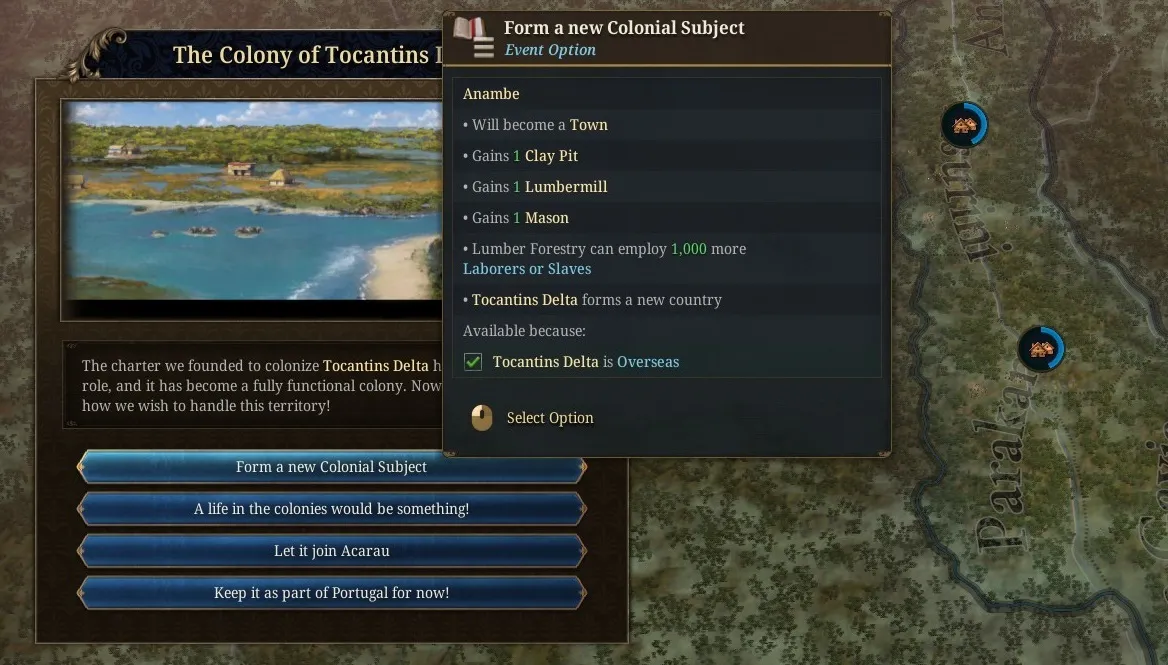
Since 1.4, you set the goal when you create the charter, according to Tinto Talks #118 and the 1.4 patch notes. A best-fit preset picks the option for you, and you can change it at any time.
Direct control gives you everything, but control falls with distance from the capital. A colonial nation sends you a share of income, sailors and manpower, per the wiki’s Subjects page. It also joins your wars when loyal, and you can build buildings and roads inside it. The catch: the Age of Absolutism cuts income from colonial subjects by 10%, then the Age of Revolutions by 20%.
Changes since release
Patches have reworked colonization several times.
- 1.0.5. Colonial nations can no longer create their own subjects or settle on an adjacent sub-continent such as North Africa, per the 1.0.5 notes.
- 1.2. The Colonial Administration building turns distant holdings into trade assets, according to Tinto Talks #103.
- 1.3. The Merge Colonies interaction lets an overlord fold one colony into another.
- 1.4. Self-sufficient colonies carry the Self Sustaining tag, progress shows an estimate, and conquistadors are built in a homeland port.
The recommended order
For a first colonial empire, work through this list.
- Research exploration advances as soon as the Age of Discovery begins.
- Explore nearby coasts before the open ocean.
- Open two or three charters on sparsely populated provinces.
- Push the Outward value to speed up migration.
- Group distant land into colonial nations.
If you are new to the game, our guide to the best countries for beginners in EU5 covers Castile, one of the six starts the game recommends. And if charters drain the treasury, our guide on why you are losing money in EU5 walks through the fixes.
Going further
FAQ
How do you colonize in EU5?
Explore the area first from the Geopolitics tab, then open a colonial charter on a province within your colonial range. Settlers of your culture and religion migrate every month until they reach the required threshold, at least 1,000 per location.Why is my colonization so slow in Europa Universalis 5?
Speed depends on colonial migration and on the number of settlers required. A large native population, malaria, a harsh climate or an Inward societal value slow everything down. Patch 1.1 also halved colonial migration.Should you create a colonial nation or keep the colony in EU5?
A colonial nation runs distant land for you and sends back income, sailors and manpower. Direct control gives you every resource, but control falls with distance. Keep strategic spots under direct rule and hand the rest to a subject.What is the best country to colonize with in EU5?
Portugal and Castile are the historical picks, with fast access to the Atlantic. But any country can colonize in EU5, especially after the Age of Discovery and the New World institution.
Sources
- store.steampowered.com /news/app/3450310/view/516347396349756464
- eu5.paradoxwikis.com /Exploration
- eu5.paradoxwikis.com /Age
- eu5.paradoxwikis.com /Situations
- eu5.paradoxwikis.com /Subjects
- store.steampowered.com /news/app/3450310/view/693142218859348304
- store.steampowered.com /news/app/3450310/view/716794361145196901
- store.steampowered.com /news/app/3450310/view/518611248440411849
- store.steampowered.com /news/app/3450310/view/679626346618421611
- store.steampowered.com /news/app/3450310/view/538883784384185176
- store.steampowered.com /news/app/3450310/view/607550616118493819