Table of contents
If you are losing money in Europa Universalis 5, the cause is almost always one of five things: low control, unprofitable buildings, weak market access, military upkeep, or debt that costs more than it brings in. Check them in that order before you disband the army. This guide is current for the 1.4 Rio Salado update released on 28 October 2026, which adds tariffs, industry promotion and new budget tools.
In practice, cutting the army is the first reflex, but rarely the most profitable one. Control and market access weigh more on your income, and they keep paying once fixed.
Control: your tax base is only worth what you control
A location’s effective tax base is its potential tax base multiplied by its control, according to the official wiki. The DBLTAP guide puts it bluntly: at 0% control, a province does not pay a single coin.
Maximum control depends mostly on proximity to the capital, with a bonus ranging from 0 to +75% according to the wiki. A large, distant conquest can therefore swell your map without adding anything to the treasury. A rich province at 20% control yields barely a fifth of its potential tax base.
What matters here: integrate your conquests, build roads toward rich provinces and avoid expanding faster than control can follow. A wide empire of low-control land often earns less than a compact kingdom with the same population.
Unprofitable buildings: spotting and fixing them
A profitable building adds its profits to the tax base; an unprofitable one is excluded from it, per the wiki. Most of the time, the building lacks its input goods: DBLTAP points to raw materials that are missing or too expensive to import. Building subsidies also show up among your expenses, so a loss-making chain costs you twice: zero tax base on one side, a subsidy on the other.
Patch 1.0.10 added a warning indicator on building cards in the location panel. Patch 1.1 also lets you lock a building’s production method so automation no longer switches it.
Three fixes come up again and again.
- Secure the inputs. Produce the raw material locally, or import it with a Trade Order.
- Change the production method. A less demanding method can become profitable again when one input is scarce.
- Destroy the building. If the market no longer wants the good, keeping the building costs money without paying anything back.
The risk is building the same workshop in every city without checking that the market has both the demand and the inputs. Ten loss-making weavers are worse than three profitable ones, because all ten drop out of the tax base while still employing pops.
A shrinking market: market access
The farther a location sits from its market center, the lower its access to that market. Developer Diary #3 explains that this cuts available goods, output and tax base. At 0% access, a location is cut off from the market’s goods entirely.

A market can also lose locations. Each location picks its market based on market attraction, market protection and its own access, according to the wiki’s Market page. Attraction grows with the owner’s prestige, the development of the center and its buildings. A richer neighbor can therefore pull your border provinces into its own market, and their trade goes with them.
Paradox lists several official remedies.
- Roads. Patch 1.0.10 raised the bonus of paved roads to 20-40% on the path to the market.
- Marketplaces and market villages. They increase market access since late 2025, according to Tinto Talks #90.
- Moving the market center. The wiki gives a cost of 800 gold, against a base cost of 250 gold to create a new market.
On paper, merging all your markets into one looks efficient. The developer diary warns that an overextended market suffers from low access at its edges. Gamer Blurb adds that destroying a market costs stability and prestige, and can send its provinces to an unexpected market.
The budget: army, navy, forts and estates
Army, navy and fort upkeep are set in the budget tab. The wiki notes that lowering army or navy maintenance reduces their morale accordingly, while lowering fort maintenance cuts defense and garrison. DBLTAP reminds players that cutting these costs is never a lasting fix.
On the income side, each estate pays the national rate on its share of the tax base. The wiki gives a tax weight of 100 for nobles, 40 for burghers, 25 for clergy and 1 for peasants. DBLTAP advises beginners to automate estate taxation, which takes the maximum without excessive unrest.
If you play peacefully, trimming the army and forts helps. But the lost morale gets paid back at the first war, usually at the worst moment.
Debt and bankruptcy
A negative balance at the end of the month triggers an automatic loan, and with no loan available, bankruptcy, according to the wiki. Since patch 1.1, bankruptcy disbands part of your units, and Tinto Talks #103 states that it wipes construction queues.
The 1.3 update added a creditworthiness score from 0 to 100. Borrowing responsibly lowers interest rates, while a default or a bankruptcy makes every later loan more expensive. Patch 1.4 adds the Default on Creditor action: it repudiates every loan held by one chosen lender, at a cost to creditworthiness, to opinion with all lenders, and with a casus belli for the former creditor.
The trap is chaining loans to pay for a war, then watching the interest outgrow what the conquest brings in. The wiki lists loans over 60 months at a base interest of 10%, so a long war on credit keeps costing years after the peace deal. Factor the loan cost into the war before you declare it, not after the first defeat.
The new 1.4 levers
Tinto Talks #124 and the 1.4 patch notes detail three tools.
- Tariffs. A market owner taxes or subsidizes foreign trade good by good, with import and export rates set separately. This is income, with a diplomatic cost.
- Trade Orders. They form a priority queue: the top order receives trade capacity first, and whatever is left trickles down to the automation.
- Promote Industry. One area gains productivity in one industry, and your pops demand more of those goods. The diary gives one slot by default, two for kingdoms and three for empires.
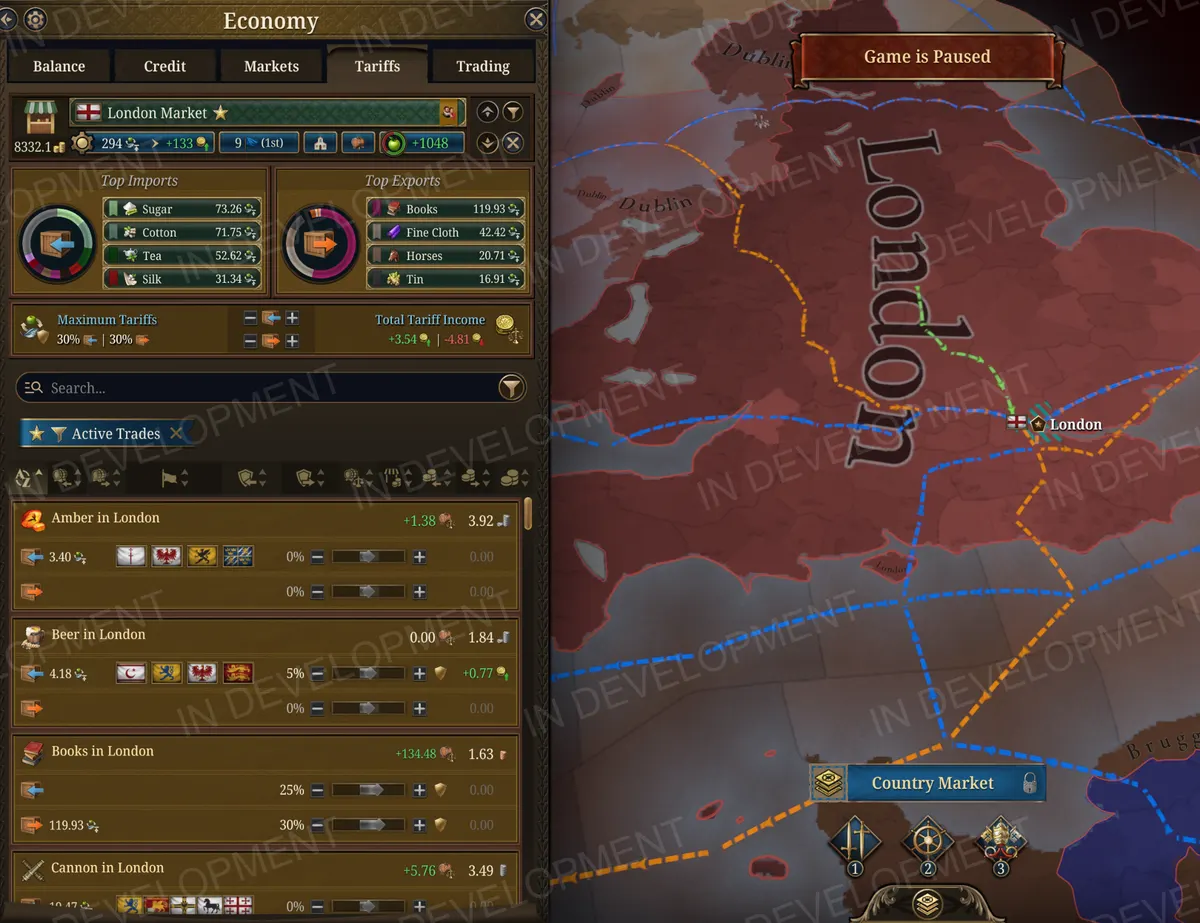
What matters in 1.4: exporting the goods you produce yourself raises their prices, which raises your tax base. The Tinto Talk describes this mercantilist approach, even when some exports run at a loss. Trade profit shrinks, but your workshops stay profitable.
The checking order
When the treasury drops, work through this list.
- Open the balance breakdown and find the largest expense.
- Check control in your richest provinces.
- Look for buildings flagged as unprofitable.
- Scan the market access map and spot the dark areas.
- Adjust military upkeep only after these four steps.
On paper this takes a few minutes per check. In practice, repeating the pass after each war or big expansion catches most leaks before they turn into loans.
If you are just starting out, our guide to the best countries for beginners in EU5 lists the starts that teach the economy, such as Hungary.
Going further
FAQ
Why am I losing money in EU5?
The most common causes are low control (the tax base is multiplied by control), unprofitable buildings, weak market access far from the market center, army, navy and fort upkeep, and loan interest. Check them in that order before disbanding regiments.Why is my market shrinking in Europa Universalis 5?
Each location joins the market that attracts it most, based on market attraction, market protection and its own access. A richer neighboring market can therefore pull your border locations away. Roads, marketplaces and moving the market center help keep them.How do you make money fast in EU5?
Raise control in your richest provinces first, fix unprofitable buildings and automate estate taxation. In patch 1.4, tariffs and export Trade Orders add another income lever, and exports also push up prices and your tax base.What happens when you go bankrupt in EU5?
Bankruptcy disbands part of your units, wipes construction queues and damages your creditworthiness, which makes every later loan more expensive. It is better to cut spending before the monthly balance turns negative.
Sources
- eu5.paradoxwikis.com /Economy
- eu5.paradoxwikis.com /Market
- store.steampowered.com /news/app/3450310/view/518598560814465362
- store.steampowered.com /news/app/3450310/view/681887658746577011
- store.steampowered.com /news/app/3450310/view/716794361145196901
- store.steampowered.com /news/app/3450310/view/503970744821088791
- store.steampowered.com /news/app/3450310/view/683005949807433815
- store.steampowered.com /news/app/3450310/view/518611248440411849
- store.steampowered.com /news/app/3450310/view/538883784384185176
- store.steampowered.com /news/app/3450310/view/503969476816929110
- dbltap.com /guides/europa-universalis-5-how-to-make-money-economy-tips
- gamerblurb.com /articles/eu5-how-to-merge-markets