Table of contents
- The six recommended countries, sorted by mechanic
- Hungary: economy without immediate pressure
- Holland: recommended, but not easy
- Naples: politics with room to breathe
- Norway: unions and decentralisation
- Ottomans: expansion through the Rise of the Turks
- Castile: the Reconquista and Iberia reworked in 1.4
- Outside the list: England and Portugal
- Countries to avoid in your first game
- Three settings before you start
- Going further
The safest way to start Europa Universalis 5 is to pick one of the six countries the game recommends in 1337: Hungary or Holland to learn the economy, Naples or Norway for politics, the Ottomans or Castile for expansion. These starts activate the learning walkthrough and its tutorial missions. This guide is up to date for update 1.4 Rio Salado of October 28, 2026.
The choice depends less on how strong the country is than on which mechanic you want to understand first. The six starts cover three families, from Buda to Bursa, and Castile remains the most played with almost one game in ten. Here is what each start teaches, what can go wrong, and the alternatives outside the list.
The six recommended countries, sorted by mechanic
The official wiki beginner’s guide sorts the recommended starts into three groups. Launching one of them from the 1337 recommended countries list triggers the learning walkthrough.
| Mechanic taught | Recommended countries | What the start trains |
|---|---|---|
| Economy | Hungary, Holland | Buildings, trade, development |
| Politics | Naples, Norway | Marriages, alliances, friendly estates |
| Expansion | Ottomans, Castile | Army, wars, integrating conquests |
Players followed that advice. In Tinto Talks #90, one month after release, Paradox noted that suggested countries are popular. Castile led with 9.90% of games started, ahead of the Ottomans (9.63%) and Holland (8.65%). Hungary (3.24%), Naples (2.78%) and Norway (1.99%) trailed far behind.
Hungary: economy without immediate pressure
Hungary starts as a Catholic kingdom centred on Buda, holding part of Croatia directly and the rest in a personal union. Its main asset is the gold and silver mines of Slovakia and Transylvania, which the wiki advises developing first.
The games.gg guide makes the same point, with natural expansion into the Balkans. The neighbours (Austria, Bohemia, Poland, Serbia, Wallachia) do not all threaten you at once. In practice, it is a good place to learn rural buildings, road-based control and gradual urbanisation.
What matters: stay on good terms with Bohemia early, then push into the Balkans through vassals rather than direct annexation.
Holland: recommended, but not easy
Holland is the trap of the list. The wiki calls it “quite a difficult start for new players” despite the game’s recommendation. The county starts in a union with Hainaut, inside the Holy Roman Empire, between Utrecht, Guelders, Brabant and Zeeland.
The DBLTAP guide adds hostile neighbours, recurring winter famines and a possible succession crisis. On paper, Holland can grow into a trade and production powerhouse. In practice, you first have to survive the neighbours and secure your markets. Skip it if you want a quiet first game.
Naples: politics with room to breathe
Naples starts as a Catholic kingdom under Robert the Wise of Anjou, with Albania and Achaea as vassals. The wiki page on Naples lists two formables, the Two Sicilies and then Italy. The beginner’s guide calls it an excellent start, “highly recommended”, with many options.
The natural path runs through Sicily, then the Papal States, which the wiki strategy suggests vassalising rather than annexing. If you play to understand diplomacy, vassals and marriages, this is the most readable start on the list.
Norway: unions and decentralisation
Norway starts in a union with Sweden, which the wiki and games.gg both present as its teaching value. The country has about 474,000 people, highly decentralised, with six towns and no founded cities. Its small subjects (Greenland, Orkney, Iceland) work as annexation practice.
What matters: stay decentralised until your subjects are annexed, since decentralisation improves their loyalty. Breaking the union with Sweden needs a spy network and a dedicated casus belli. It is a slow start, useful for learning laws and subjects rather than war.
Ottomans: expansion through the Rise of the Turks
The Ottomans start from Bursa, among the Anatolian beyliks, facing Byzantium and the Ilkhanate. They are the leading country of the Rise of the Turks situation, according to the wiki and games.gg. Unique events and reforms act as a guiding thread.
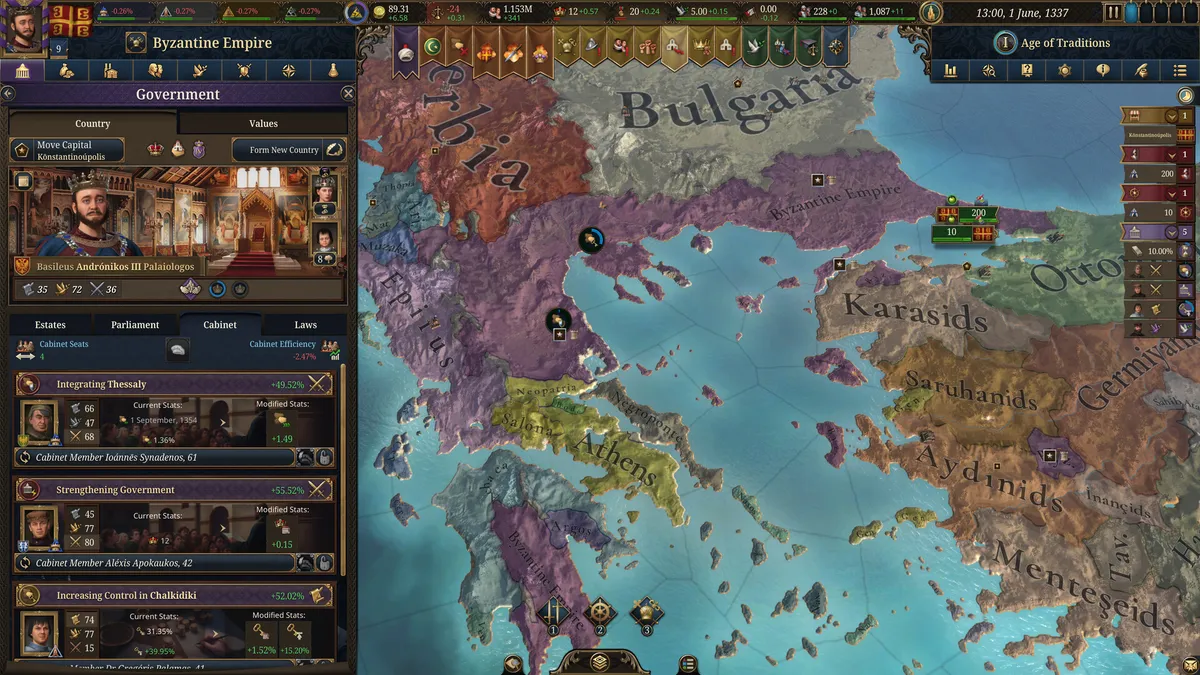
The long-term goal remains Constantinople. The risk, according to games.gg, is expanding too fast, which triggers rebellions. In practice, vassalising neighbouring beyliks before annexing them limits the problem and teaches culture and religion management.
Castile: the Reconquista and Iberia reworked in 1.4
Castile under Alfonso XI borders Aragon, Granada, Navarre and Portugal. Granada is backed by Marinid Morocco, and Castile can eventually form Spain and then colonise. The wiki rates this start between beginner and intermediate.
Update 1.4 changes the region. The Rio Salado update notes add 315 advances for Iberian and Maghrebi countries, with unique events, decisions and buildings for Castile, Aragon and Granada. The paid Across the Pillars DLC adds the Battle of the Strait situation between Castile, Morocco and Granada.
One caveat: some Castile guides advise recruiting mostly cavalry. Update 1.4 rebalances cavalry and infantry so that an all-cavalry army is no longer the meta, according to Paradox. Read those older tips with care.
Outside the list: England and Portugal
Two countries often appear in guides without being among the game’s recommendations, so they come without the learning walkthrough.
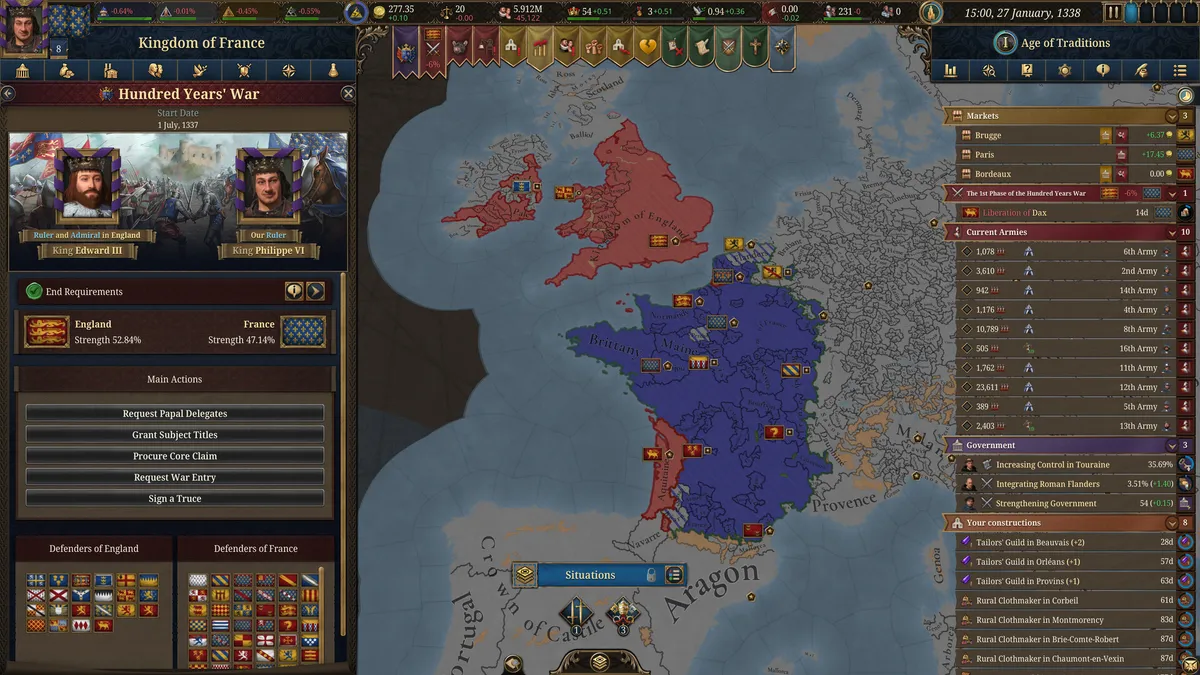
England starts with large French holdings and hostile Scots to the north. The Hundred Years’ War comes very early, which DBLTAP describes as a crash course in warfare. You can defend the continent, claim the French crown or give those lands up.
Portugal has few rivals on the peninsula, and early events make good relations with Castile easier, according to DBLTAP and games.gg. It is a start geared towards exploration and trade. With 1.4, it also benefits from the Iberian content and the new expeditions system.
Countries to avoid in your first game
The games.gg beginner’s guide warns against three profiles.
- Byzantium. The empire starts surrounded by stronger neighbours, and the game leaves little time to learn.
- Granada. The Nasrid kingdom borders Castile, which aims at the Reconquista from the start.
- Small Holy Roman Empire states. They lack the room and the army to survive the first wars.
What matters: an exposed country is not impossible, but it punishes mistakes before you understand what caused them.
Three settings before you start
First, start from a new save. The 1.4 FAQ states that a 1.3 game loads, but its balance may become unrecoverable, and Paradox recommends starting over.
Next, keep the learning walkthrough missions active: they give bonuses and goals designed around each mechanic. Finally, plan a second game with another group of countries. A Hungary game followed by an Ottoman game covers both the economy and war.
What matters most in a first campaign is reading tooltips rather than racing the clock. The risk of a fast start is missing why your income or stability drops, which the walkthrough missions are there to explain.
A first campaign also does not need to reach 1837. Playing the first age to around 1400 is enough to see the walkthrough missions through, then start again with a better grasp of markets, estates and control. On paper that sounds slow; in practice it is the fastest way to stop guessing.
If you come from EU4, our EU4 vs EU5 comparison details what changes in the learning curve.
Going further
FAQ
What is the easiest country for beginners in EU5?
The game recommends six starts in 1337: Hungary, Holland, Naples, Norway, the Ottomans and Castile. Naples and Hungary offer the calmest openings. Holland, although recommended, is exposed inside the Holy Roman Empire.How do you start the Europa Universalis 5 tutorial?
Pick one of the recommended countries on the 1337 country selection screen. The game then activates the learning walkthrough and its tutorial missions, split into economy, politics and expansion.Should you restart your campaign with patch 1.4?
Yes. Paradox says a 1.3 save loads in 1.4 Rio Salado, but balance issues may become unrecoverable, and it recommends starting a new save.Which countries should you avoid in your first EU5 game?
Guides advise against Byzantium, Granada and small Holy Roman Empire states: they start surrounded by stronger neighbours and require mastering the game before you can survive.
Sources
- eu5.paradoxwikis.com /Beginner%27s_guide
- eu5.paradoxwikis.com /Hungary
- eu5.paradoxwikis.com /Naples
- eu5.paradoxwikis.com /Norway
- eu5.paradoxwikis.com /Castile
- eu5.paradoxwikis.com /Ottomans
- store.steampowered.com /news/app/3450310/view/503969476816929110
- store.steampowered.com /news/app/3450310/view/716794361145196901
- store.steampowered.com /news/app/3450310/view/716794361145197022
- dbltap.com /guides/europa-universalis-5-best-nations-for-beginners
- games.gg /europa-universalis-v/guides/europa-universalis-v-best-nati…
- games.gg /europa-universalis-v/guides/europa-universalis-5-ultimate-…