Table of contents
For your first company in Victoria 3, aim at the construction chain: iron, wood, then steel. Then compare with your country’s historical companies, because the first nation to establish one keeps it. No official ranking exists, so this order is our reading of the rules and of player opinions.
These rules come from the wiki’s Companies page, verified for version 1.13. The preliminary 1.15 changelog, published on 29 October 2026 for a release announced on 5 November, adds five free companies in Eastern Europe. It also gives Copper Mines to several companies, including Basic Metal Mining. Check the values in your own campaign before you commit to a plan.
What makes a company profitable
Every company shares the same base effect. According to the wiki, the buildings it owns gain +10% throughput, and the buildings it constructs gain +30% construction efficiency. The throughput bonus scales with the share of levels the company owns. Prestige rank adds a further bonus: +10% for the top ten countries, up to +20% in total for rank one.
What matters, then, is not the name on the panel but the buildings it covers. Four rules shape your choice after that.
- Slots. Corporate Charters opens the first one, then society technologies add more, up to 5 after Macroeconomics. Technocracy or the Companies III principle adds one more.
- The threshold. You need 5 levels of an associated building in a single state, owned by private owners, the nation or both.
- The commitment. An established company cannot be disbanded for 5 years, and a disbanded company cannot return for 4 years.
- Going over the limit. Beyond your slots, each extra company reduces the bonuses, down to a multiplier of 0.33.
The 2023 dev diary notes that the vast majority of countries do not start with this ability. Corporate Charters therefore deserves an early place in your research queue, especially if you want the construction bonus while your economy is still small.
Which companies to establish first
The wiki lists the rules without recommending a choice. The order below draws on two Steam threads, from June 2024 and July 2025. Those threads do not amount to a consensus, and the names are the wiki’s: what you see on screen can differ by country.
| Order | Company | Buildings covered | Bonus at 100 prosperity |
|---|---|---|---|
| 1 | Basic Metal Mining | Iron and lead mines | +10% steel mill throughput |
| 2 | Basic Forestry | Logging camps, rubber plantations | +0.7 infrastructure from population |
| 3 | Basic Steel | Steel mills, iron and coal mines | +5% state construction efficiency |
| 4 | Basic Metalworks | Tooling workshops, steel mills | +5% manufacturing throughput |
| 5 | Basic Home Goods | Glassworks, furniture manufactories | +7.5% loyalists |
| 6 | Basic Textiles | Textile mills, cotton, silk | −10% radicals |
Iron comes first: one player explains that it earns or saves the most early on, because of construction demand. Wood follows for the same reason, and its bonus helps poorly connected states. Steel ranks third because it first requires 5 levels of steel mills, which most countries do not have ready when the first slot opens.
Consumer goods come later. Another player sums up the logic: your bottleneck then becomes tax revenue and standard of living, which is why textiles and food take over at that stage.
The United Construction Conglomerate stands apart. Its +20% construction sector throughput is tempting, but it requires 10 levels of steel mills, tooling workshops or glassworks, plus a power bloc with the Construction III principle. Treat it as a mid-game goal rather than a first choice.
Historical or basic company?
Basic companies are open to everyone. Flavored companies depend on a state or a culture, and two countries cannot establish the same one. The AI prefers them, and the wiki sums up the rule in one phrase: first come, first served. The required levels must belong to the establishing country or its citizens.
On Steam, players often rate them higher, especially those that grant a prestige good. Here are some examples taken from the wiki list, verified for 1.13.
| Country | Company | Main condition | Bonus at 100 prosperity |
|---|---|---|---|
| Belgium | John Cockerill | Present at the start | +10% railway throughput |
| Prussia | Friedrich Krupp | Present at the start | +10% railway throughput, +10% kill rate |
| Sweden | LKAB | Open Hearth Process, Norrland, 5 levels of iron mines | +20% iron mine throughput |
| France | Compagnie des mines d’Anzin | French Low Countries, 5 levels of coal mines | +10% railway, +5% steel mill throughput |
| United States | Standard Oil | Pumpjacks, Atlantic Coast, 5 levels of oil rigs | +20% railway throughput |
| India | Tata | Bombay, 5 levels of textile or steel mills | +5% construction sector throughput |
| Colombia | Panama Canal Company | Panama Canal or 5 levels of ports | +1 free charter, +25% trade advantage |
One pattern stands out: the railway bonus. If you are playing a country that is building its network, these companies are worth the slot. Note that Krupp and Cockerill already exist at the start: you do not need to establish them, only to make them prosper.
Which order for your country
Three profiles emerge from these sources, each with different priorities.
- Industrial country. Follow the table order, then add historical companies tied to steel or railways.
- Small or poor country. TheGamer advised in 2023 to research Corporate Charters early and establish an agriculture or raw-resource company.
- Plantation country. One player suggests a coffee company for South America or Asia, because it is cheap and needs no inputs.
Should you swap companies every 5 years?
One player in the 2024 thread switches companies every 5 years, because the construction bonus is worth more to them than the main bonus. They keep only steel. On paper, the rules allow it, since the disbanding lock lasts 5 years.
The cost is real, though. The disbanded company stays locked for 4 years, and the next one starts again from 0 prosperity. If you are playing to learn, keep your companies and focus on their profitability instead.
How to reach 100 prosperity
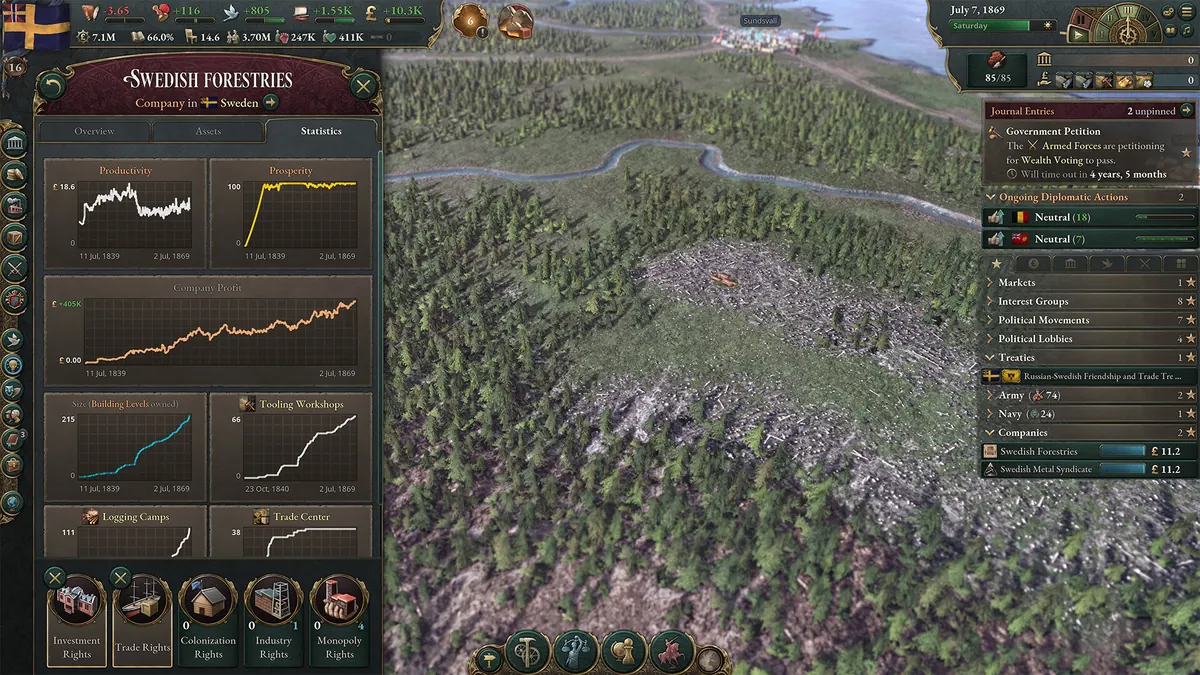
Each company’s own bonus activates at 100 prosperity and disappears below 75. A company starts at 0 and moves toward its target by 0.2 to 1 point per week. That means at least 100 weeks, almost two years, and far longer if it performs poorly.
The target adds three elements: relative productivity (up to 50), fully employed levels (up to 50) and the executive’s popularity. Since update 1.13, that popularity can no longer lower prosperity and adds 10 points at most.
In practice, you need both at once: profitable buildings and enough staff. Do not open more levels than your population can fill, or the bonus will stay out of reach.
Charters and monopolies with Charters of Commerce
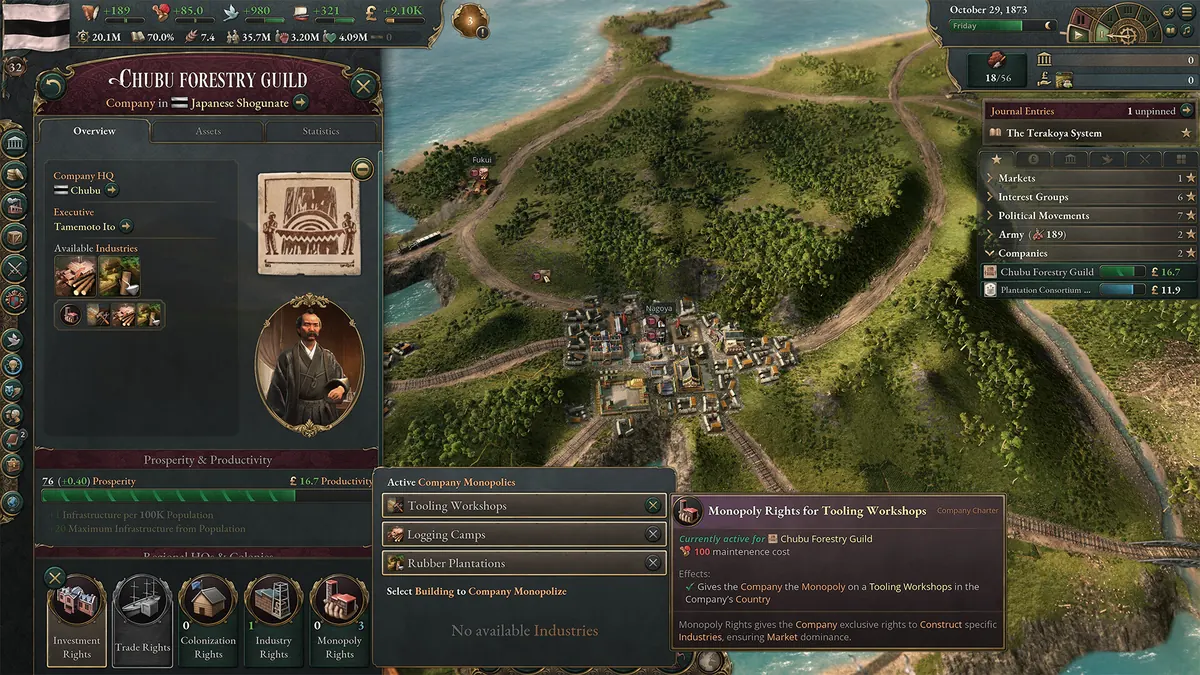
The Charters of Commerce pack, released on 17 June 2025, adds charters. Each country receives at least one free charter, and the next ones cost 100 authority.
- Trade. The company can run trade centers.
- Investment. It opens a regional headquarters in a country where it owns 5 buildings.
- Colonization. It creates a chartered company country.
- Industry. It adds a building type to its activities.
- Monopoly. It gets −80% on privatizing the buildings involved.
The dedicated dev diary explains that a monopoly raises the selling price, and therefore the market price. The risk is obvious on a good your construction consumes: a steel monopoly makes your own building projects more expensive. Monopoly and investment charters also cannot be revoked for 5 years.
What has aged in older guides
Be wary of old figures. TheGamer’s guide from November 2023 mentioned level 10 buildings and 25% construction speed, where the wiki for 1.13 gives 5 levels and +30%. Its prosperity rises past a productivity threshold, whereas update 1.9 replaced that with a target value.
Update 1.13 also added 11 companies with The Great Wave, plus 4 free ones. Before you follow a ranking, check its date and open the list in your own campaign.
Going further
FAQ
What is the best company in Victoria 3?
There is no official ranking. For your first one, aim at the construction chain: Basic Metal Mining, Basic Forestry, then Basic Steel. Then compare with your country's historical companies, which players often rate higher. Later in the game, textiles and food become more useful, because standard of living and tax revenue start limiting your growth.How many companies can you have in Victoria 3?
According to the wiki for version 1.13, Corporate Charters opens the first slot, and later society technologies add more, up to 5 after Macroeconomics. Technocracy or the Companies III power bloc principle adds one more. You can exceed this limit, but each extra company reduces your bonuses, down to a multiplier of 0.33.How do you establish a company in Victoria 3?
Research Corporate Charters, then gather 5 levels of an associated building in a single state. Those levels can belong to private owners, the nation, or both. Historical companies add their own conditions, such as a specific state or technology. Once established, a company cannot be disbanded for 5 years.Do you need Charters of Commerce to have companies?
No. Basic companies are available to every country without this pack. Charters of Commerce mainly adds charters, monopolies and prestige goods, and some historical companies require a specific DLC. The pack helps if you want to specialize your companies, but it does not change which company you should establish first.
Sources
- vic3.paradoxwikis.com /Companies
- vic3.paradoxwikis.com /List_of_flavored_companies
- store.steampowered.com /news/app/529340/view/5839532486210927602
- store.steampowered.com /news/app/529340/view/806818250769825979
- store.steampowered.com /news/app/529340/view/535507353628312141
- store.steampowered.com /news/app/529340/view/680765564125184919
- store.steampowered.com /news/app/529340/view/680764929940133504
- store.steampowered.com /app/3450170/Victoria_3_Charters_of_Commerce/
- paradoxinteractive.com /games/victoria-3/add-ons/victoria-3-charters-of-commerce
- thegamer.com /victoria-3-companies-prosperity-explained/
- steamcommunity.com /app/529340/discussions/0/604160355563786431/
- steamcommunity.com /app/529340/discussions/0/6234751432450832873/
- #Victoria 3
- #Paradox
- Guide