Table of contents
- What is official as of October 26, 2026
- Vikings: an economy that pushes you out of the base
- Scots: an economy you have to protect
- Two philosophies, one shared balance risk
- The Crucible: four missions and two-player co-op
- Two biomes, not ready-made maps
- Which profile for which civilization
- What to check after October 29
- Going further
Raiders of the North arrives on October 29, 2026, and the period of vague promises is over. The Age of Empires team has detailed both civilizations, described the four Crucible missions and previewed Update 17.0, which ships alongside the expansion. What is still missing is the numbers: costs, hit points, speeds and yields are not published in detail. A Vikings-versus-Scots ranking would therefore be fiction. The official descriptions do, however, make it possible to read two opposing ways of taking control of the tempo of an Age of Empires IV match.
What is official as of October 26, 2026
The expansion is a PC release on Steam, where the DLC page lists a release on October 29, 2026 and a price of 19.99 EUR in France. Pre-orders have been open since late September. Update 17.0 lands the same day for every player, with quality-of-life improvements and targeted balance changes. The team says these aim to increase landmark diversity and bring civilizations closer in line with each other.
That detail matters. The Vikings and the Scots arrive in a game that is changing at the same moment, which makes any comparison with today’s ladder fragile. The full list of changes sits in the official patch notes, which this article does not replace.
This piece extends our first article on the Raiders of the North announcement, written when only the broad strokes were known. Since then, two dedicated posts have described each civilization age by age.
Vikings: an economy that pushes you out of the base
According to the official post, the Vikings are a civilization of raiding, mobile infantry and early naval strength. Their economic hook is unusual: Villagers are not recruited the normal way. They appear automatically and for free until a capacity cap is reached. The Longhouse raises that cap and takes economic attachments, such as farmsteads or bee skeps for food and gold. From the Feudal Age, further attachments slowly research armor and damage upgrades.
Sagas are quests that can be completed at any time and grant economic or military bonuses. The post cites actions such as raiding enemy buildings, hunting and trading. The Völur, a unique religious unit, can boost Longhouse production or be sacrificed to establish a Sacred Grove on a Relic. That grove slowly produces Berserkers, dual-axe infantry that enrage as their health drops. Bondi, Berserkers and Hirdman form the core of the army.
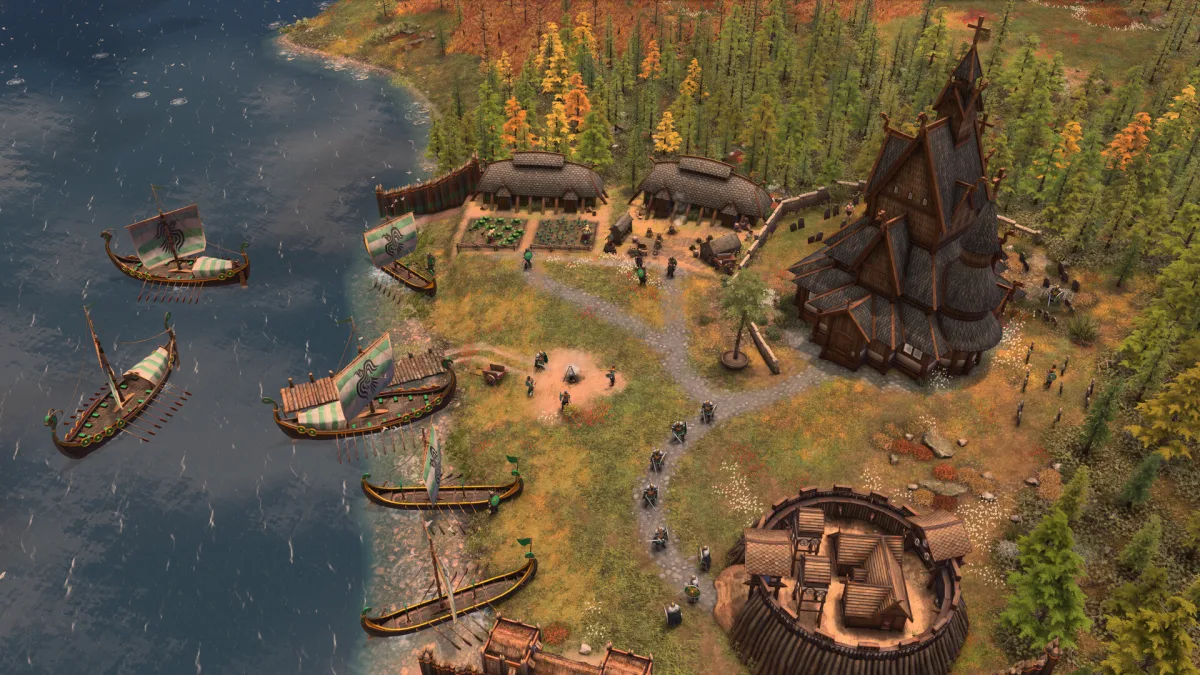
Later in the match, the identity shifts. The move from the Viking Age to the Scandinavian kingdoms brings Knights and Militia Crossbowmen. The post also details Danevirke walls, which replace palisades with far more durability, and a population cap raised to 210, then 220 with a cathedral technology.
This design has a clear consequence. The Viking economy is built so the player does not sit still: free Villagers release resources, and Sagas reward activity across the map. The question the ladder will answer is how dependent the civilization is on them. If Sagas become mandatory, the Vikings are locked into a single plan. If they stay a bonus, the civilization gets real freedom.
Scots: an economy you have to protect
The Scots are the mirror image. The official post describes a civilization of disciplined infantry, fortified defense and a strong food economy. Its food comes from Highland Cattle, which graze on Berry Bushes for bonus food. Tower Houses produce and shelter them, which makes them, according to the team, a prime target for enemy raids.
The army is organized around the schiltron, built from Pikemen supported by Men-at-Arms with Lochaber axes and by Gallowglass. The Scots also have Stealth Forests: their infantry can see directly through them and ambush from within. The Mustering Hall lets you muster reinforcements quickly by spending food. It also holds Lowland and Highland technologies, which cost less when you build a landmark from the matching region.
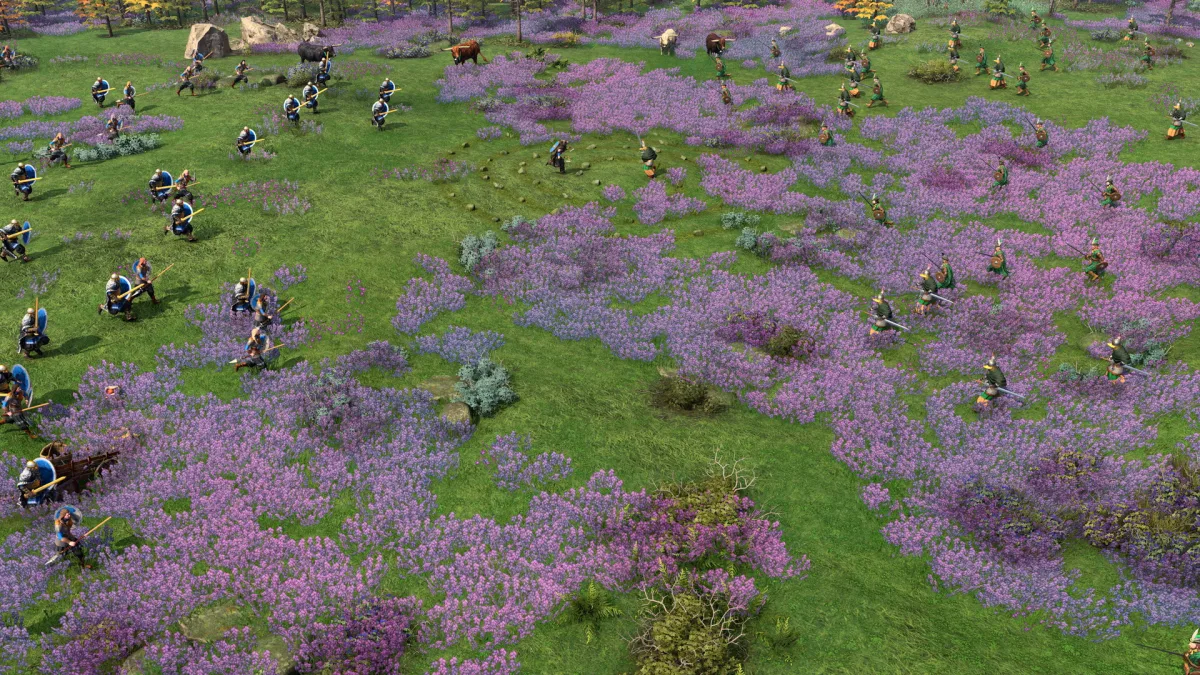
The age-by-age breakdown fills in the rest: the landmark choice between Lowlands and Highlands, Fishponds worked by Kirkmen, and Border Reivers for raiding deep into enemy territory. The Highlands-or-Lowlands choice is therefore not cosmetic. It steers everything that follows.
The weak point is written into the design. Cattle that are vital to the economy are also an obvious target, and the official post says so openly. If the Vikings manage to threaten them, the promise of Scottish resilience will be tested within the first minutes.
Two philosophies, one shared balance risk
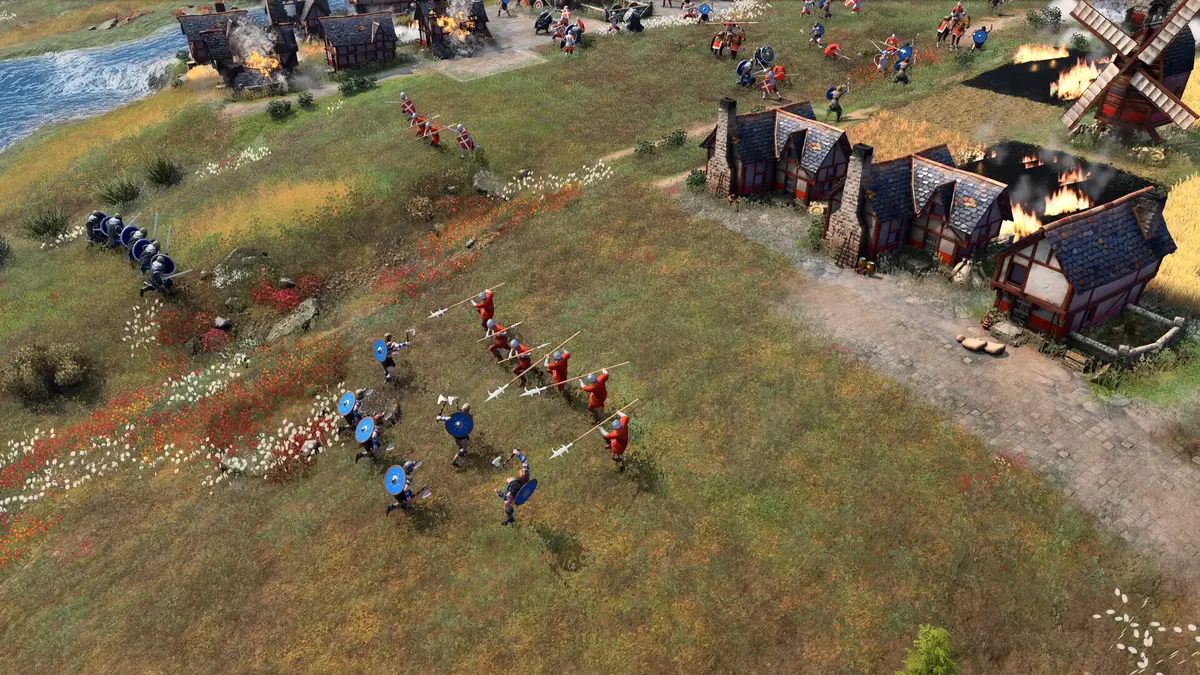
The Update 17.0 preview sums up the tension well: the Vikings look to build momentum through aggression, while the Scots are equipped to hold their ground and force hard-fought engagements. One poses an urgent question; the other tries to make the answer expensive.
That opposition is more interesting than two different unit lists, because it contrasts ways of making decisions. It also carries two symmetrical risks. Vikings who lean too hard on raiding would become exhausting to play. Scots whose cattle are too easy to protect would neutralize the opponent’s initiative without taking enough risk. The contrast only succeeds if each side stays punishable.
Our position is plain: the design is convincing on paper, and that is exactly why certainty deserves suspicion. No matchup rule, optimal build order or civilization ranking is defensible before several weeks of real games.
The Crucible: four missions and two-player co-op
The Crucible, the mode introduced with Dynasties of the East, is being expanded. Owners of Dynasties of the East get the base changes with the October 29 update: two-player co-op, a large batch of new Boons, a reworked progression system, and two extra modes, Conqueror and Custom. Owners of Raiders of the North also get four exclusive missions.
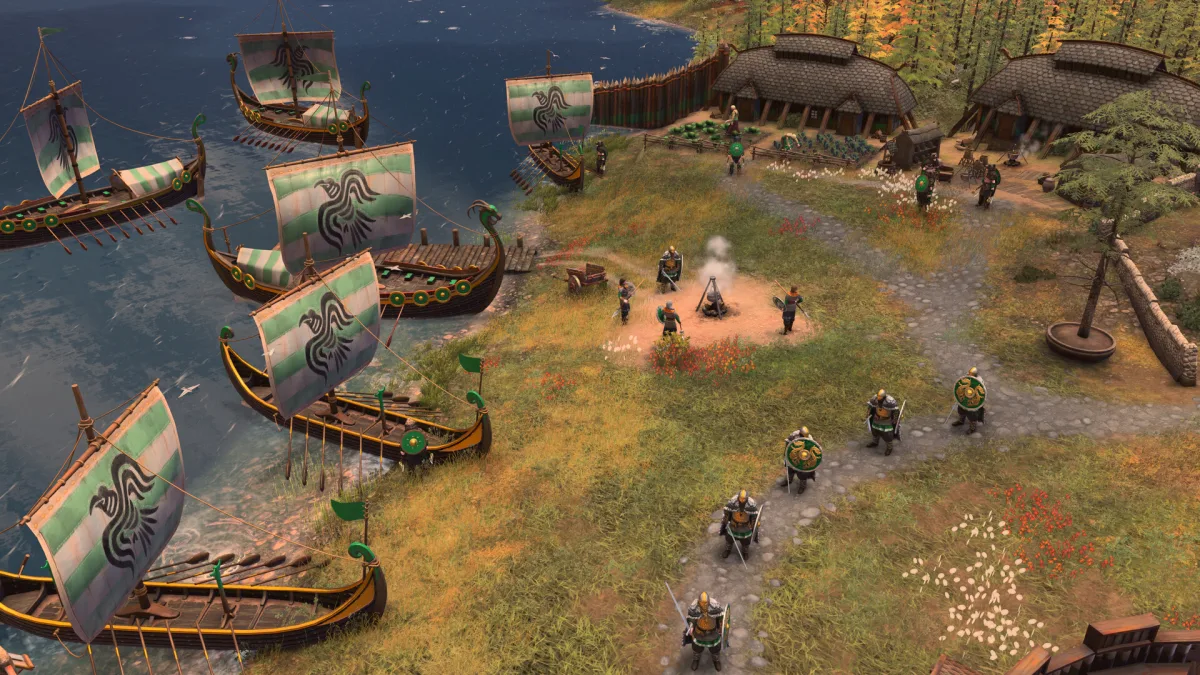
The four missions, all playable solo or in pairs with difficulty scaled for co-op:
- Sea Raiders: Viking longships crash onto your shore.
- Scottish Isthmus: northern clans face Scots loyal to the English crown.
- Lost Desert: Templar fortresses guard a desert.
- Thunder & Trumpets: the elephant cavalry of the Tughlaq charges through the Sundarban jungle.
Each civilization also gets its own 15-level Talent Track, with a free Boon Ascension at the final tier. It is a gentler setting than the ranked ladder for getting to know a civilization.
Two biomes, not ready-made maps
The expansion adds the Scottish Heathland and Tundra Summer biomes. The first evokes mist, heather and lochs; the second a northern land that thaws for a few weeks, with cotton grass and red shrubs. A biome changes the look and mood of a terrain, not the structure of maps, their coastlines or forest density. Saying the heathland will favor longships or that the tundra will slow land raids would be speculation.
Which profile for which civilization
At this stage, appeal is a better word than recommendation. The table below pairs each preference with what the official sources describe and what remains to be measured.
| What attracts you | Civilization to watch | What remains unknown |
|---|---|---|
| Raiding and mobile infantry | Vikings | Real profitability of Sagas |
| An economy with no Villager queue | Vikings | Cost and pace of Longhouse expansion |
| Disciplined infantry, schiltron | Scots | Costs, counters and unit mobility |
| Ambushes from Stealth Forests | Scots | How easily they are countered on open maps |
| Choosing between Highlands and Lowlands | Scots | Real flexibility of the Mustering Hall |
This table is not a power verdict. It summarizes design intentions and unknowns.
What to check after October 29
Four points will settle things quickly. The first is the real pace of the Viking economy without a Villager queue, and the share Sagas take in competitive games. The second is how exposed Scottish cattle are to early raids. The third is the place of naval play on water maps, especially with the new biomes. The last is the effect of Update 17.0 on the existing civilizations, since balance shifts at the same time the expansion arrives.
The first test comes on October 29, with Update 17.0 and both civilizations becoming playable at once. If Sagas turn out to be mandatory, or if Scottish cattle fall within minutes, the announced contrast loses its value. Until ranked games settle those two points, naming a winner would be theater.
Going further
- All our Age of Empires IV articles
- Age of Empires IV: Complete Guide Civilizations & Strategies 2026
- Age of Empires 4: Raiders of the North — Vikings & Scots Confirmed for Fall 2026
- AoE4 Raiders of the North out now: Vikings, Scots, and what Update 17.0 means for every player
Main sources: official Vikings post, official Scots post, Crucible overview, Update 17.0 preview, DLC Steam page and Gematsu.
Sources
- steamcommunity.com /games/1466860/announcements/detail/719043624313029951
- steamcommunity.com /games/1466860/announcements/detail/719043624313029432
- steamcommunity.com /games/1466860/announcements/detail/719043624313030866
- steamcommunity.com /games/1466860/announcements/detail/719044258722482203
- steamcommunity.com /games/1466860/announcements/detail/698776793839043920
- ageofempires.com /news/age-of-empires-iv-update-17-0/
- store.steampowered.com /app/4336170/Age_of_Empires_IV_Raiders_of_the_North/
- gematsu.com /2026/06/age-of-empires-iv-anniversary-edition-expansion-ra…