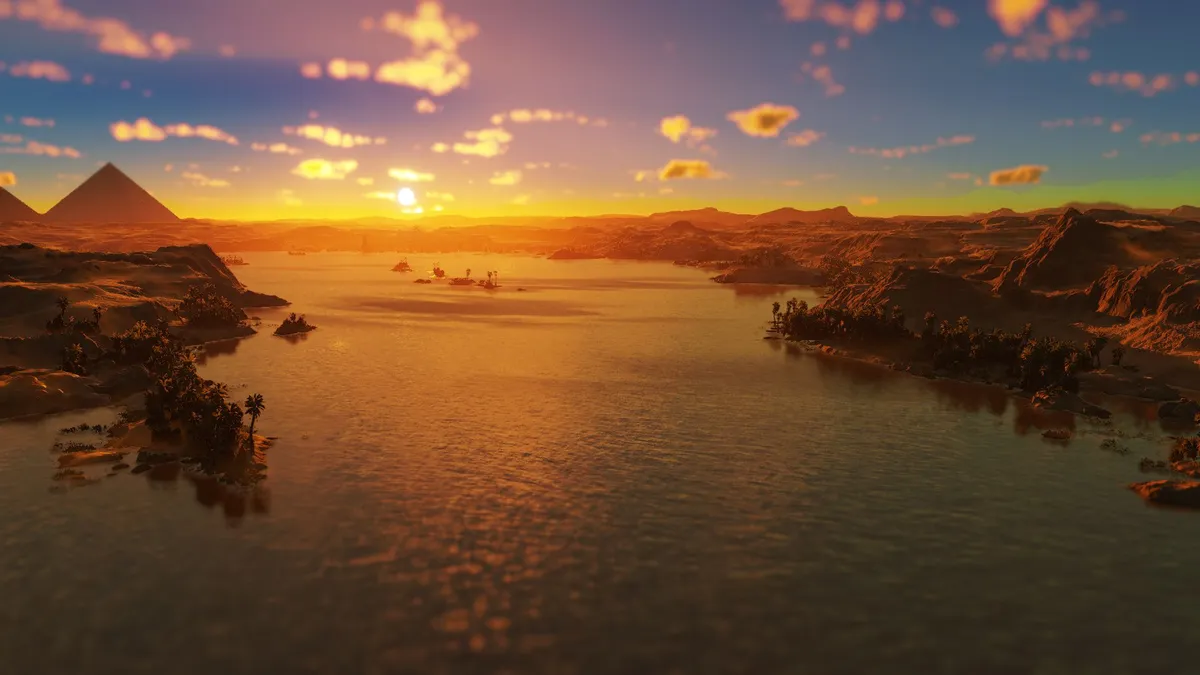
Ten days before launch, Dawn of the Delta changes the nature of the terrain in Anno 117: every island in Aegyptus is split into three zones, and the Nile decides what works there and in which season. The expansion releases on November 5, 2026, alongside update 3.0, and it is the largest of the year-1 gameplay DLCs. This preview relies on the official Anno Union DevBlogs and roadmap, since no hands-on play is available.
Aegyptus: a river province in three zones
Latium and Albion are archipelagos: islands separated by the ocean, where a fertile tile stays fertile. Aegyptus breaks with that logic. As the October 15 DevBlog explains, a river rather than the ocean separates the buildable areas. The islands sit closer together, but their elongated shape can lengthen some trips. The province can only be entered from the north, so the first settlement location needs thought.
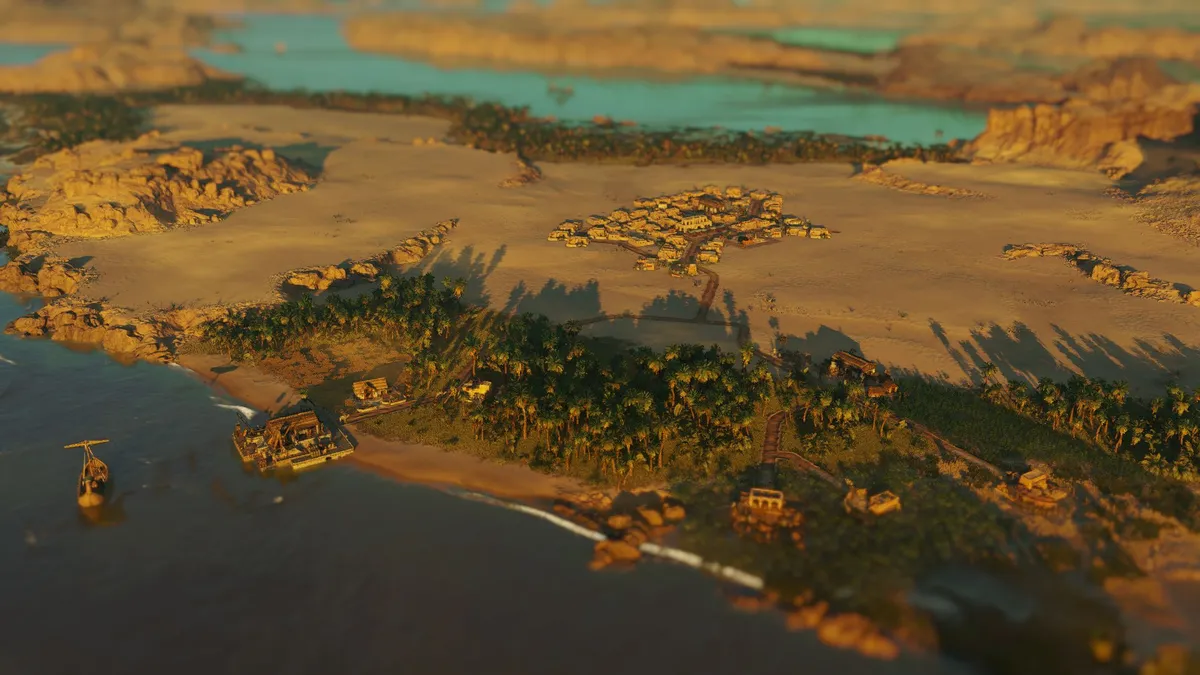
Each island is split into three zones. The Farmlands form a green strip near the coast, useful for agriculture, and they are the only place to build the harbour. The Floodplains run along the river: they are regularly flooded, which disrupts the production of buildings placed there. Finally, the Arid Zone covers the inland: nothing grows there, at least for now, but space is plentiful for building cities.
The developers suggest placing residences, public services and the Governor Villa there. They also suggest putting production buildings in the Arid Zone to avoid wasting fertile land. Nearby cliffs offer mountain slots to mine ore or rock. The river flows from south to north, which affects ship speed, and it slows down the heavy Roman ships.
The floods: a quantified risk, a reward
This is the expansion’s central mechanic. The October 22 DevBlog gives the numbers: during the flooding season, the productivity of every building in the Floodplains drops by 75%. Health falls by 2 and fire safety rises by 2 on all buildings across the province.
The harvest season that follows acts as compensation. The same notes add that it raises the output of every production building in the Floodplains by one ton per cycle. The October 15 DevBlog sums up the idea: fertile mud increases production, but the flood season needs watching. The Floodplains are used to harvest mud and reed, turned into sun-dried bricks, or to grow wheat and barley.
Wood is not needed to build in Aegyptus: players must produce mud bricks from reed and mud, both found in the Floodplains. That detail matters, because it makes the flood zones unavoidable from the start of a game. The real issue is therefore absorbing periodic production drops in exchange for a regular bonus, rather than avoiding the risk.
Two population paths, two ways to irrigate
The first population tier is the Threshers, local Egyptians focused on farming. A choice then follows, as in Albion: follow the local path or Romanize. The Egyptian path leads to the Potters, then the Chanters. The Graeco-Roman path leads to the Scribes, then the Gymnasiarchs.
Each path brings its own needs:
- Potters ask for stuffed goose, beer, talismans and oil lamps.
- Chanters want blue lotus tea, perfumed oils and sistrums.
- Scribes ask for bread, cheese, soap, olive oil and scribing sets.
- Gymnasiarchs demand rare meat, bird tongues in aspic, jewelry and bath milk.
Irrigation is the second big choice. The Egyptian approach is to build basins on the coast and then canals inland: within a radius of eight fields on each side of the canal, land is watered and becomes Farmland. This turns Arid Zone into agricultural land, at the cost of city space. The developers mention the appeal of building dedicated farmland islands.
The Roman approach is only available once the Romanized population reaches tier 3, the Gymnasiarchs. A giant noria lifts water from the river, which travels through aqueducts to cisterns. Each cistern supplies bath houses and irrigates a circular area, creating extra Farmland.
Granaries, production and rats
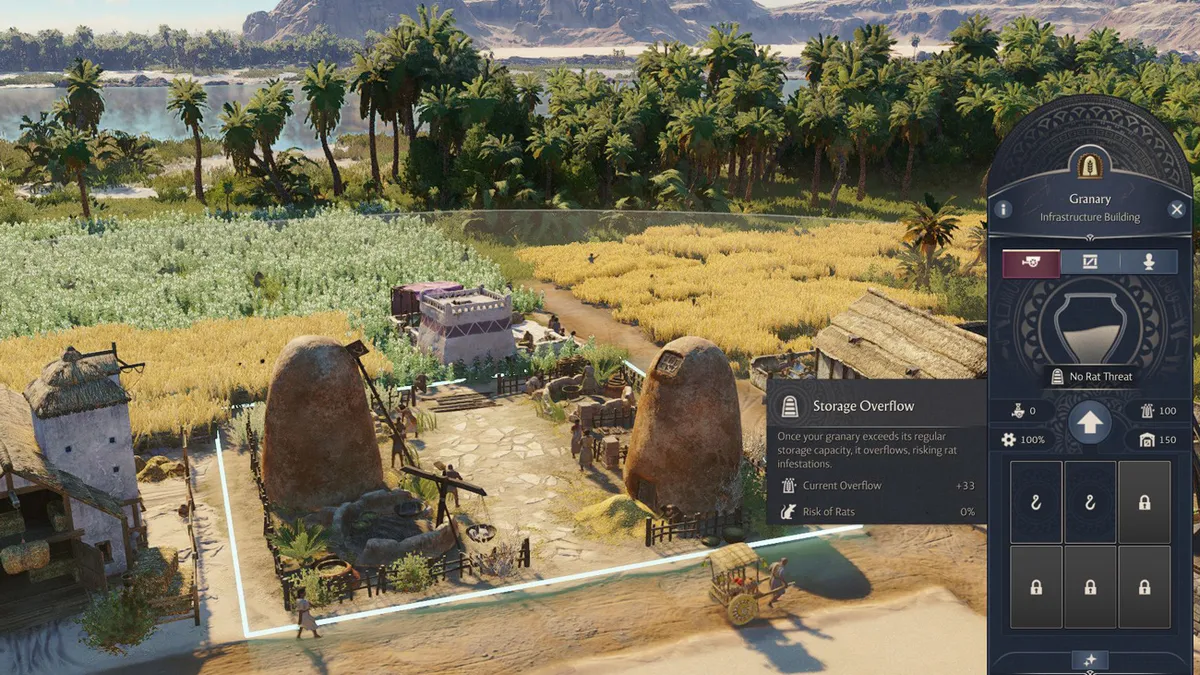
The Granary is a building specific to Aegyptus. Within its range, it raises farm productivity by 15% and gives a population bonus of +1. It also provides 100 tons of storage for agricultural goods, useful for export or for getting through the flood season.
The downside is overflow risk. Exceeding the storage limit slowly makes granaries overflow, which can attract rats and reduce the island’s health. The higher the overflow and the lower the granary level, the higher the risk. Upgrades and certain specialists help to limit it.
Production chains offer alternatives to those in Latium and Albion. The developers cite three examples: talismans, scribing sets and sistrums, each using local inputs such as copper, sand, papyrus or beads from the Floodplains. The stated goal is to multiply choices: produce bread in Latium, Albion or Aegyptus, or import soap rather than make it locally.
Religion, units and ships
The expansion introduces three new deities, including Sobek, god of the river delta. In the Gamescom presentation, his worshippers devote more attention to managing water, which boosts irrigation and farms. The other two deities will be detailed in the third DevBlog, announced for October 29.
On the military side, two land units are specific to the province. The elite archers cost more to recruit and maintain, but shoot farther, with more accuracy and damage. The October 22 DevBlog calls them Kumatic Archers, while the Gamescom presentation spoke of Kushite archers. The Dromedarii, camel cavalry, are stronger against other mounted units and a little cheaper, but cannot keep up with horses in a chase.
Two new local ships are built at a dedicated shipyard. The small Skiff carries three cargo slots and has no weapons. The Galley carries five after research, with a military variant. The developers state that Roman ships remain better for naval battles. The local boats are faster on the delta, and the suggested approach is to transfer goods to heavier ships near the ocean.
What to watch before November 5
For players already settled, the expansion can be played as a starting province or explored in an existing savegame with the DLC enabled. Links between provinces matter: Aegyptus can become a breadbasket while luxury goods come from Latium.
Four points remain to be checked at launch:
- The balance between the Egyptian path and the Graeco-Roman path, which may not be equivalent.
- How much a 75% drop during floods hurts a critical production chain.
- The content of the third DevBlog, which is due to cover deities, story, characters and the pyramids.
- The detail of update 3.0, for which the roadmap lists an expanded statistics menu and a “Stamp” feature to save layouts.
The expansion is included in the Year 1 Pass, sold at 34.99 EUR on Steam, alongside Prophecies of Ash and The Hippodrome. The sources consulted give no standalone price. First player impressions, expected from November 5, will show whether the promise holds up in practice.
Going further
- The complete Year 1 Pass roadmap details the three gameplay DLCs and their schedules.
- The previous DLC is analyzed in Anno 117 Prophecies of Ash.
- The Hippodrome’s material needs are covered in the patch 1.6.1 news.
- Every article about the game is gathered on the Anno 117 page.
- To unlock the base game’s second province, follow our guide on how to get to Albion.
Sources: Anno Union roadmap · Union Update · Gamescom recap · DevBlog Oct 15 · DevBlog Oct 22 · Ubisoft · Steam · Gamepressure · Playday
Sources
- anno-union.com /roadmap-for-2026/
- anno-union.com /union-update-aegyptus-is-calling-community-spotlight/
- anno-union.com /gamescom-recap-dawn-of-the-delta-and-echoes-of-kassandra/
- anno-union.com /devblog-arriving-in-aegyptus/
- anno-union.com /devblog-population-floods-and-the-power-of-knowledge/
- ubisoft.com /en-us/game/anno/117-pax-romana/news-updates/4jz0kxVkH6JAk5…
- store.steampowered.com /app/3749050/
- gamepressure.com /games/anno-117-pax-romana-dawn-of-the-delta/z1742d
- playday.one /2026/09/05/anno-117-pax-romana-dawn-of-the-delta-hands-off…