Europa Universalis 5 review: the grand strategist is back in force
- Six years in the making: EU5 modernizes the formula without breaking it.
- Diplomacy reworked: alliances, betrayals and royal marriages carry real weight.
- Tactical warfare: defined unit roles, terrain and supply lines now matter.
- A more intuitive economy: production centers and strategic resources.
- Verdict — an essential buy: the best entry point into the series so far.
A long-awaited return after 6 years
Six years. Six long years since Europa Universalis 4, the last opus of a series that shaped generations of strategy players. When Paradox Interactive announced Europa Universalis 5, expectations were enormous. After months of teasers, betas and speculation, the game is finally here. So, does this new entry redefine the genre or merely polish an already well-oiled formula? Spoiler: a bit of both, and it is very good news. Europa Universalis 5 does not revolutionize the series, but it modernizes it with intelligence. The core gameplay remains the same – running a country over several centuries, between diplomacy, wars and economic development – but almost every mechanism has been reworked for more fluidity and depth. For players coming from EU4, the transition feels natural, with the impression of playing a far more accomplished version.
A diplomatic system finally up to par
One of the big weak points of Europa Universalis 4 was its diplomacy, often too simplistic and predictable. EU5 fixes this with a far more dynamic and realistic system. Relations between nations are no longer reduced to a simple opinion number: alliances are more fragile, betrayals more frequent, and royal marriages finally have a real impact.
The new “Diplomatic Play” system is particularly well thought out. Instead of declaring war like a brute, you now have to justify your actions to the other powers. Do you want to annex a province? You will have to convince (or bribe) other countries to look the other way. This system adds an extra strategic layer and makes every conflict far more immersive. Another major novelty: the “Great Powers”. These dominant nations carry far more diplomatic weight and can impose their will on smaller states. If you play France or Spain, you will love it. If you embody a small German duchy, prepare to scheme to survive.
War, more tactical and less chaotic
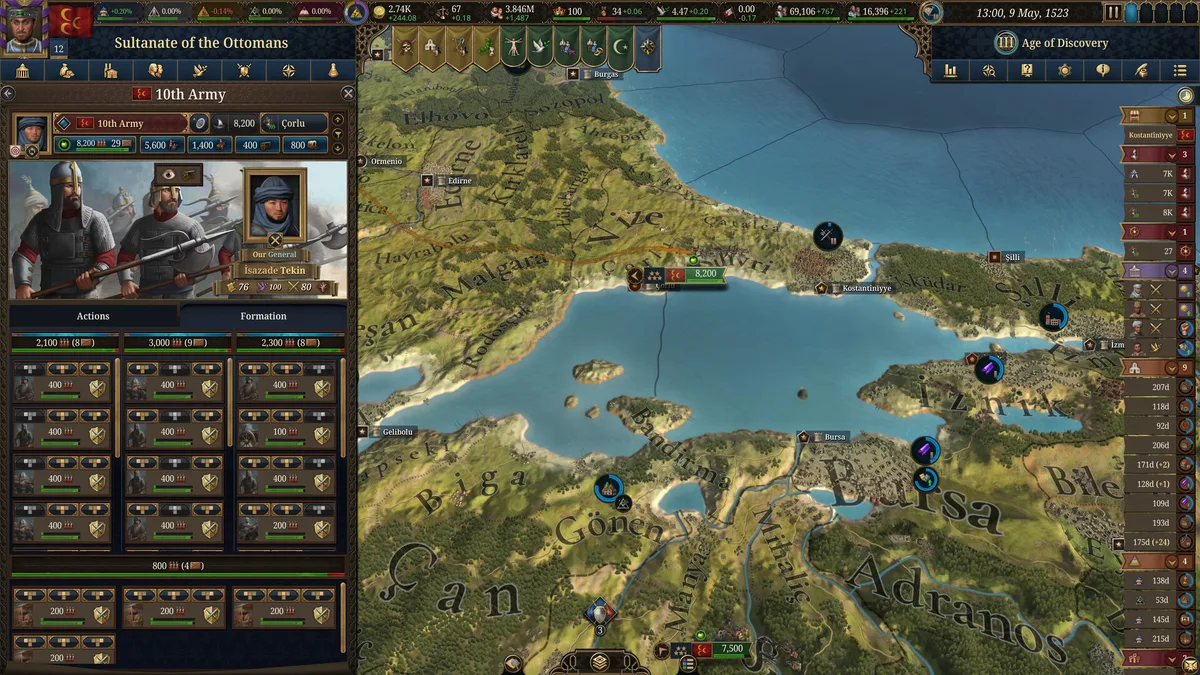
Combat has always been a sensitive point in the Europa Universalis series. In EU4, battles could sometimes look like a big mess where army size mattered more than tactics. EU5 changes the game with a far more structured warfare system. First, units now have well-defined roles: infantry holds the lines, cavalry charges the flanks, and artillery pounds the defenses.
In practice, terrain plays a crucial role: an army in the mountains will be far more vulnerable than on a plain. Finally, generals have unique skills that can turn a battle around. The siege system has also been reworked. Gone are the impregnable forts that block your advances for years. Now you have to manage your supplies, your reinforcements, and even the morale of your troops. A besieged city can surrender from starvation before you even have to give the assault. The result: wars are longer, more tactical, and far more satisfying when you win a hard-fought victory.
The economy, more intuitive but still complex
Managing your economy in Europa Universalis was often a headache. EU5 simplifies some mechanics without dumping the depth. The trade system has been reworked to be more intuitive: trade nodes are still there, but managing them is less punishing for new players. Buildings have also been redesigned. Instead of building dozens of manufactories to boost your economy, you now have “Production Centers” that group several bonuses. Less micro-management, but just as many possible strategies. On the resource side, the game introduces a “Strategic Resources” system (wood, metal, grain, etc.) that adds an extra management layer. A grain shortage can spark riots, while a surplus of metal will let you build more weapons. Nothing revolutionary, but it adds realism and difficult choices.
A redesigned tech tree for more variety
In EU4, technologies often unlocked in a linear way, with little real choice. EU5 breaks this routine with a far more open tech tree. You can now specialize your nation in different domains: military, economic, diplomatic or cultural. Each choice has a real impact on your gameplay. A diplomacy-focused nation will find it easier to form alliances, while a military power will overwhelm its enemies with superior units. And above all, you are no longer forced to follow the same path as everyone else. National traditions (the unique bonuses of each country) have also been reworked to be more impactful. Playing England, the Ottoman or Japan really gives the impression of embodying a unique nation, with its strengths and weaknesses.
An AI finally worthy of the name
Artificial intelligence has always been the Achilles’ heel of Paradox games. In EU4, the AI could sometimes make completely aberrant choices, like declaring war on a superpower without any preparation. EU5 greatly improves this. AI-run nations now have clear and coherent objectives. France will try to control Western Europe, the Ottoman will seek to expand its empire, and small states will try to survive by playing the balancing act. Alliances are also better managed: the AI will no longer drop you in the middle of a war just because it found a better ally. Of course, there are still moments where the AI makes debatable choices, but overall, it is a huge step forward. Solo games are finally as interesting as multiplayer, with a campaign that holds up on its own.
Multiplayer as addictive as ever
Paradox has always excelled at multiplayer, and EU5 does not disappoint. Whether cooperative or competitive, the game is designed for epic games between friends (or enemies). The real-time pause system lets you discuss strategies without pressure, and the diplomacy tools between players are well thought out. You can form secret alliances, betray your allies, or even play the mediator to avoid a total war. The only real flaw is that games can become very long (as in every EU). But when you spend 10 hours plotting with your buddies to overthrow the Ottoman Empire, you do not see the time pass.
Graphics and immersion: a leap forward
EU5 is not a “next-gen” game when it comes to graphics, but it makes a huge leap compared to EU4. The map is far more detailed, with more precise borders and smoother animations. The 3D models of units and buildings are also far more polished. But the real progress is immersion. Historical events are better integrated, with illustrations and texts that bring your game to life. When you sign a peace treaty or crown a new emperor, you really feel like you are making History. The soundtrack is also excellent, with epic music that adapts to the situation. A calm melody for periods of peace, war drums when conflict approaches… Everything is done to immerse you in the atmosphere.
Verdict: the best Europa Universalis to date
Is Europa Universalis 5 revolutionary? No. Is it the best opus of the series? Without any doubt. Paradox listened to player feedback and fixed almost every flaw of EU4. Diplomacy is deeper, wars more tactical, the economy more intuitive, and the AI finally credible. The game remains complex, but it is far more accessible to new players without sacrificing the depth that makes the series charming. For players who love historical strategy, EU5 is an essential buy. If you are discovering the series, it is the best possible entry point. And if you had dropped EU4 because of its flaws, this new entry should make you want to come back. So, ready to rewrite History? Because with Europa Universalis 5, you finally have the means.
See also
- Europa Universalis 5 — game hub
- EU5 Patch 1.3 Pavia: Italy Expands to 200+ Nations and Central Banks Enter the Game
- EU5 Fate of the Phoenix: will Paradox finally give Byzantium the treatment it deserves?
- Europa Universalis V Console Commands: Test a Campaign Without Breaking It
- All grand strategy games
Sources
FAQ
How long did Europa Universalis 5 take to develop?
Six years separated Europa Universalis 5 from Europa Universalis 4, after months of teasers and betas.What is new in EU5 diplomacy?
A Diplomatic Play system, more fragile alliances, frequent betrayals and royal marriages with a real impact, plus the Great Powers.Is EU5 warfare more tactical than EU4?
Yes, units have defined roles (infantry, cavalry, artillery), terrain matters, generals have unique skills and sieges require supply management.Is the EU5 economy easier to manage?
Trade and buildings are more intuitive, with Production Centers and a Strategic Resources system (wood, metal, grain).Should I buy Europa Universalis 5?
For historical strategy fans, EU5 is an essential buy and the best entry point into the series.